
Can I keep part of the security deposit?
The tenant is out, the keys are on the counter, and there is a hole in the living room wall that was not there when they moved in. At least you are pretty sure it was not. That word, pretty, is how landlords lose deposit cases. Here is what I do so I am never guessing.
I have run my own rentals in central Pennsylvania since 2020, thirteen units across three duplexes, a triplex and a quad. The most expensive deposit mistake I see landlords make is not charging too much. It is keeping money they cannot prove they are owed. No move-in record, no photos, a number written on the back of an envelope, and a refund that goes out late or not at all. The tenant files at the magistrate, the landlord says the wall was fine when they moved in, the tenant says it was already like that, and the person with nothing on paper loses. In a lot of states the landlord then owes a penalty on top of the deposit.
So the record starts the day the tenant moves in, not the day they move out. The tenant on this page is a composite I will call Marcus, and the screenshots are from a demo duplex in my own account, but every step is the one I take. He was in the unit almost three years on a $1,050 deposit, and he left behind two real problems and a stove that just got old.
What I do, from move-in day to the refund
1Move-in day: a photo walkthrough on my phone, before the tenant gets the keysPro plan
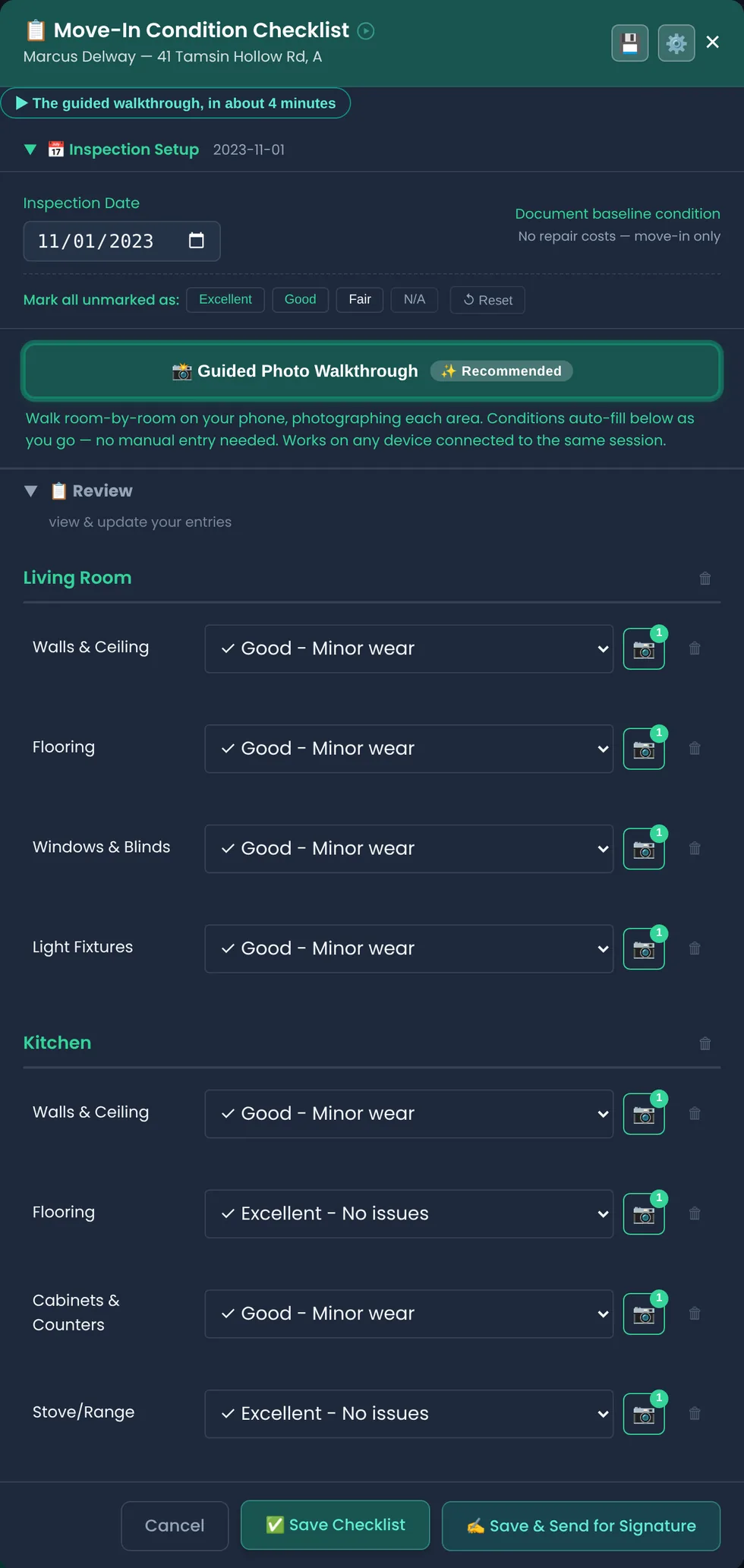
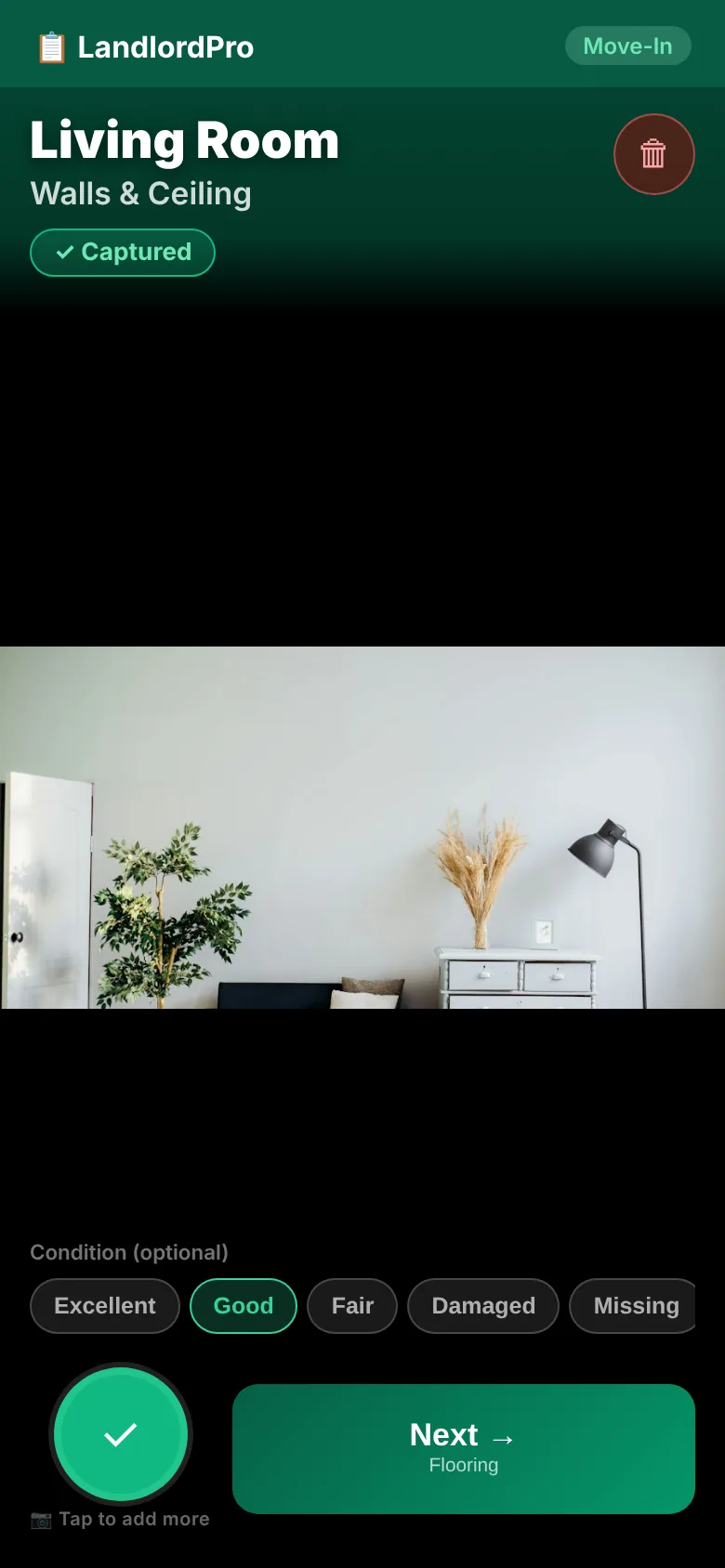
The move-in checklist is the one document the whole deposit rests on, and it used to be the one I rushed. Now I start it on the computer, point my phone at the code on the screen, and walk the unit with the phone. It takes me through each room one item at a time: walls and ceiling, flooring, windows, light fixtures, then the kitchen appliances, the bathroom, the bedrooms, the keys. One photo, one tap for the condition, next item. When I finish, Send to Desktop drops every photo and condition into the checklist with the inspection date on it.
That is the baseline. It says the living room wall was Good on November 1, and there is a photo of it attached to that line. I save it to the tenant's record, and there is a button to send it to the tenant to sign. Most tenants never look at it again. I look at it on the last day of every tenancy.
2Move-out day: the same walk, with the move-in condition next to every item
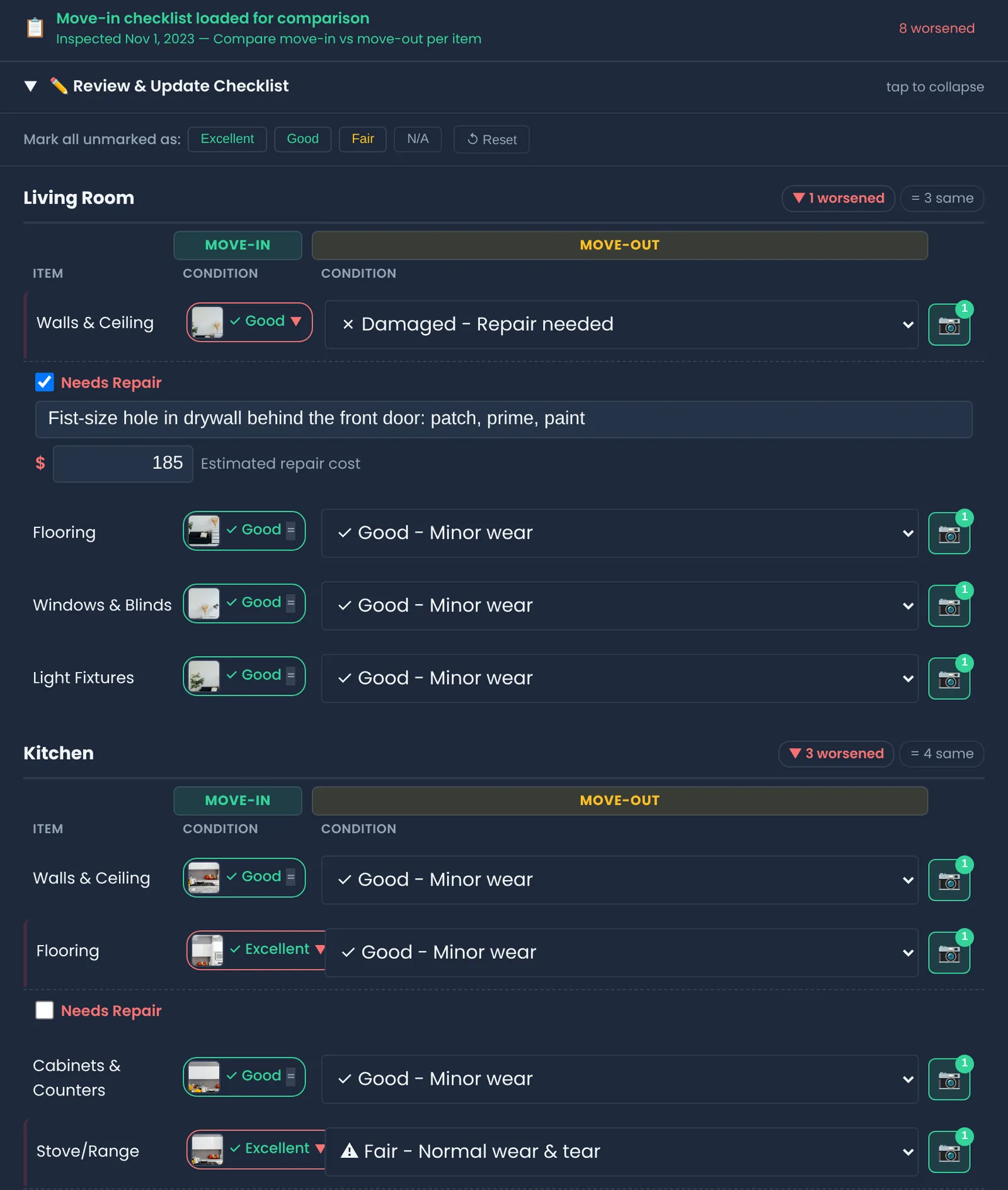
When the tenant leaves I walk the same rooms in the same order, and this time the phone shows me what I recorded at move-in for every item. Living room walls: move-in Good. Today there is a fist-size hole behind the front door, so it is Damaged, Needs Repair, a short description and what it will cost. Bedroom carpet: move-in Good, now a pet stain. Same thing.
Back on the computer the checklist lines the two inspections up side by side and counts what got worse in each room. This is also where I stay honest with myself. The stove went from Excellent to Fair after three years of cooking. That is normal wear and tear, and normal wear and tear is not the tenant's bill. It goes on the record as Fair with no repair cost, and it is not on the list of deductions.
3One line for every dollar I keep, with how I know the cost
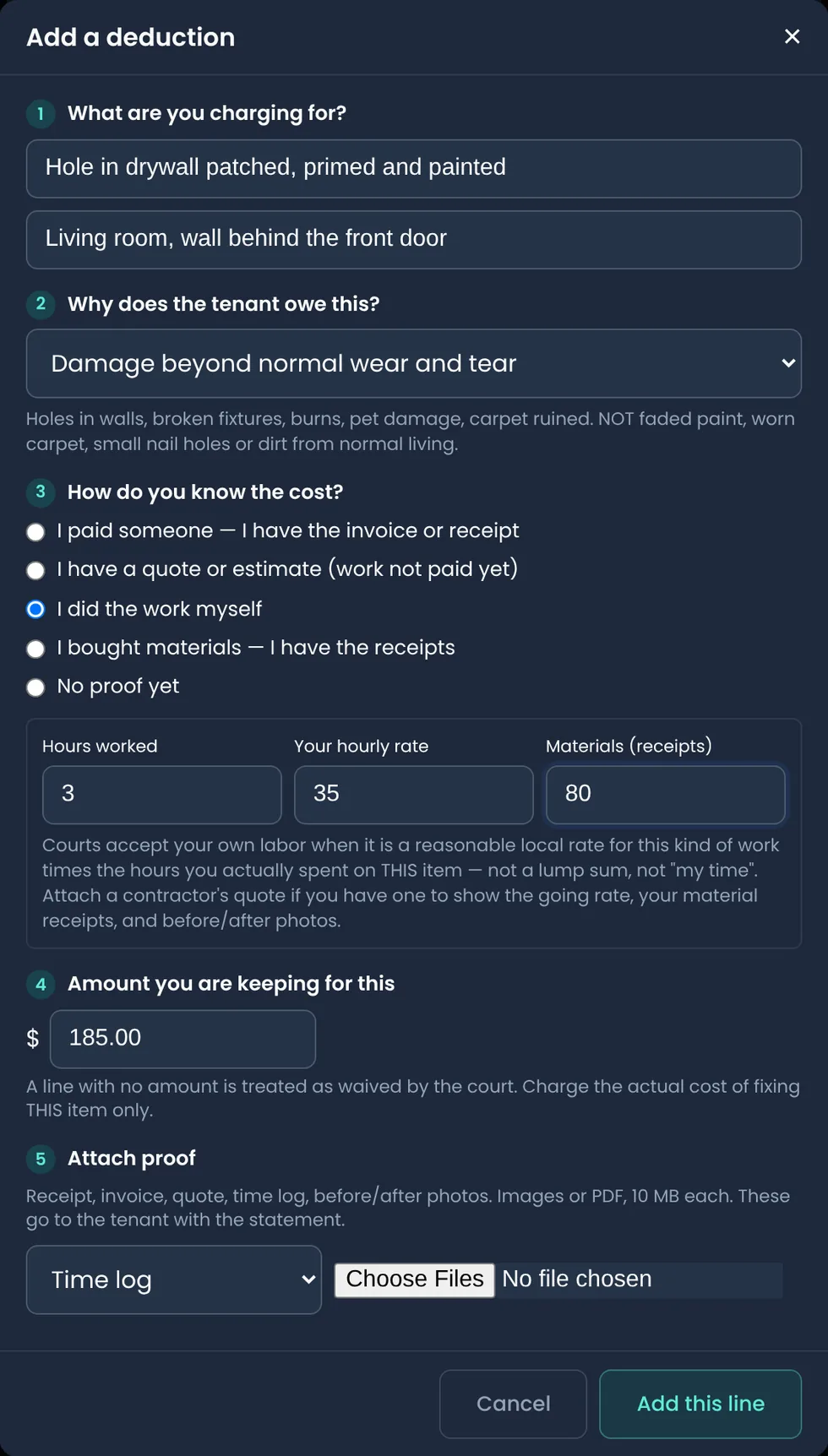
This is the part that actually decides deposit cases. Every dollar I keep gets its own line: what it is for, where in the unit, why the tenant owes it, how I know what it cost, and the amount. The panel warns that a lump sum mixing unrelated jobs gets thrown out, and it pushes back on the excuses I might be tempted to use. The reason list says in plain words that faded paint, worn carpet and small nail holes are not damage.
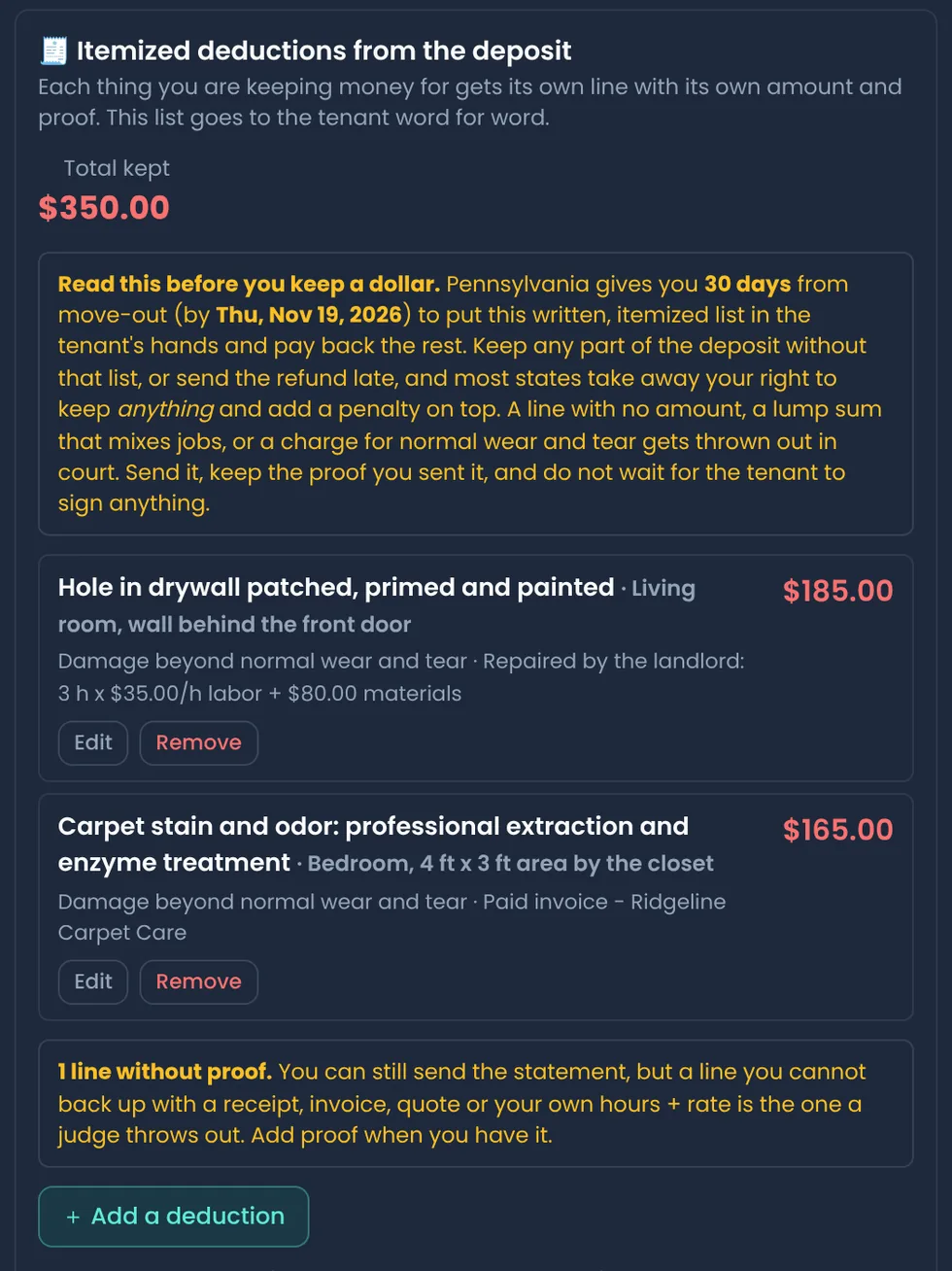
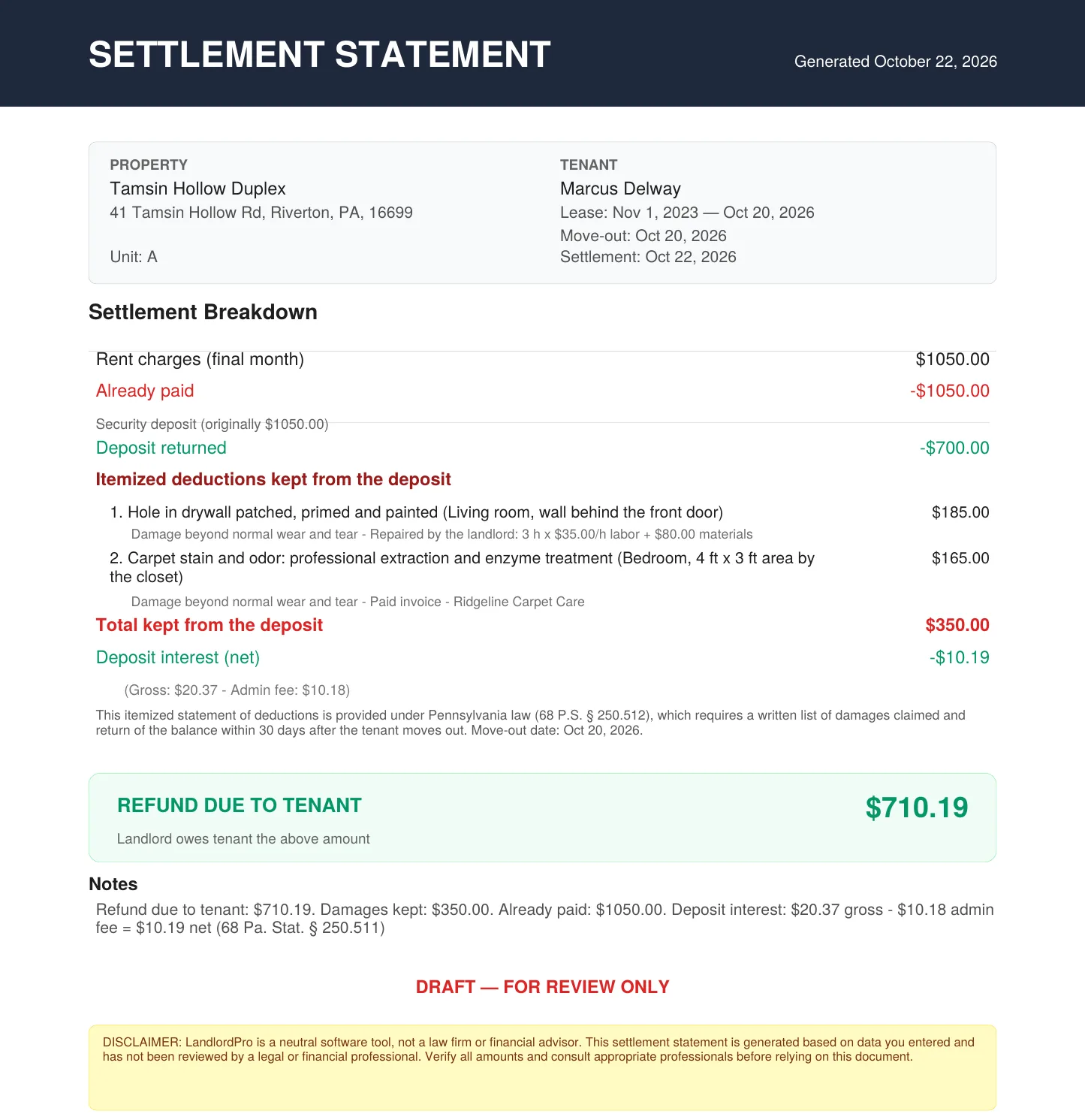
I patched that drywall myself, so the line says three hours at $35 an hour plus $80 of material, not a round number I made up. The carpet went to a cleaning company, so that line is a paid invoice. If a line has no receipt, invoice, quote or time log attached yet, the panel says so in yellow. Mine still has one of those, and I fix it before anything goes to the tenant.
4The clock: the deadline, the refund, and the interest
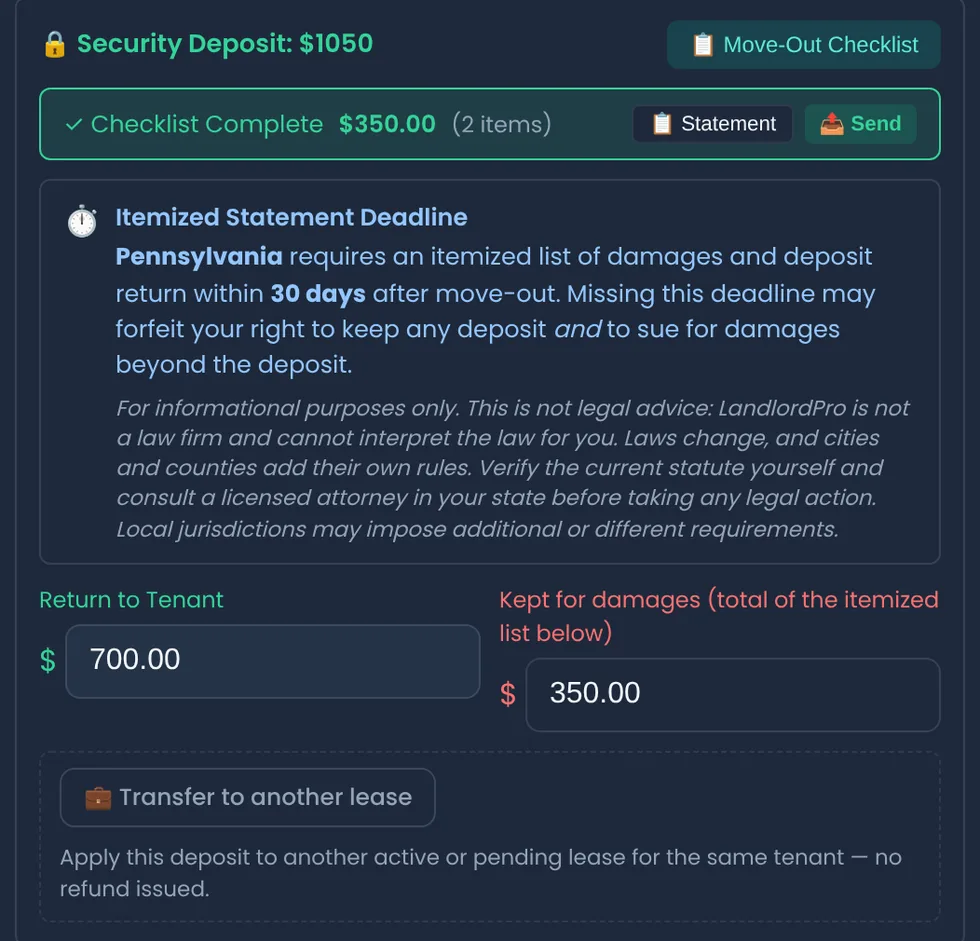
Keeping money is only half of it. The other half is a deadline, and it is the one landlords miss. For a Pennsylvania property the app uses 30 days from move-out to get the itemized list to the tenant and pay back the rest, and it puts the actual date on the screen. Its Pennsylvania warning is blunt: keep any part of the deposit without that list, or pay late, and you can lose the right to keep anything at all. Your state's number may be different, and the law changes, so check your state's current rule before you rely on any app, including mine.
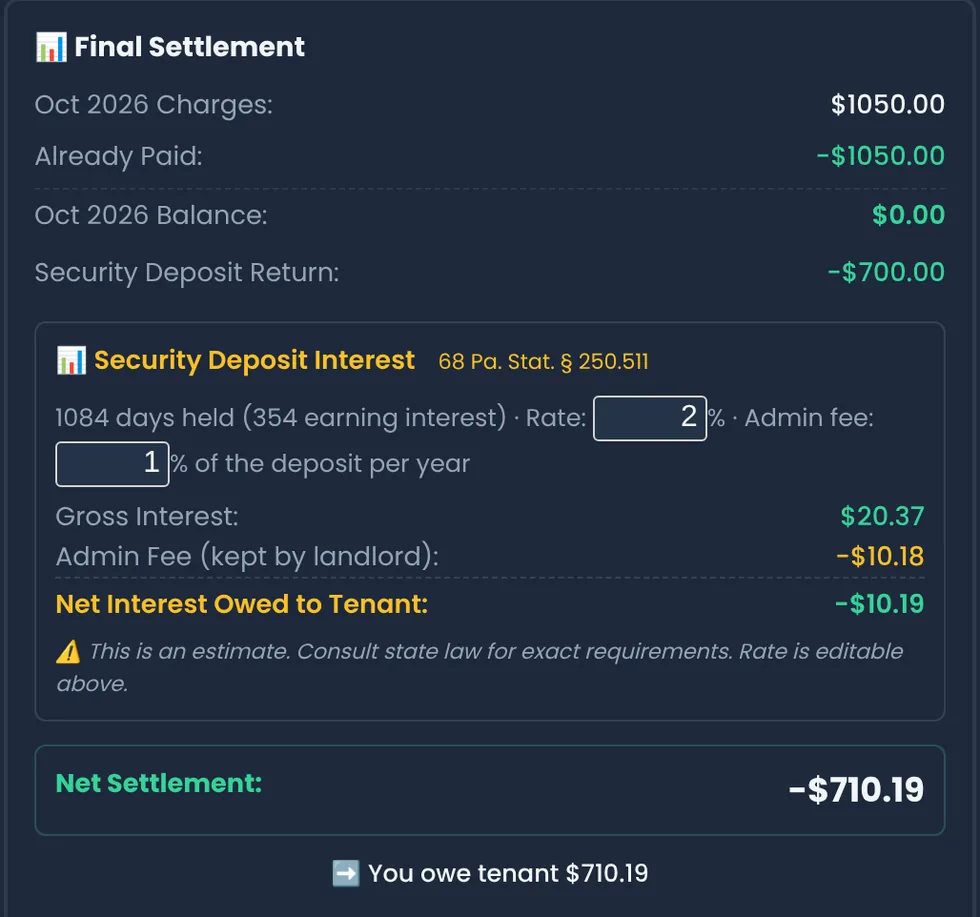
Then the math. The deposit minus what I kept is the refund, and the final month's rent is netted in from the rent roll so nothing is counted twice. Marcus was in the unit almost three years, and that brings in deposit interest. For a Pennsylvania property the app only counts interest after the deposit has been held two years: of his 1,084 days, 354 earn interest. It takes the landlord's administrative fee as 1% a year of the deposit, not of the interest, so on a small deposit about half the interest goes to the fee. The rate is editable and the line is labeled an estimate. That is how the app reads Pennsylvania; check your state's current law. The bottom line says, in plain words, that I owe the tenant $710.19. It is not legal advice and it does not pretend to be.
For informational purposes only. This is not legal advice: LandlordPro is not a law firm and cannot interpret the law for you. Laws change, and cities and counties add their own rules. Verify the current statute yourself and consult a licensed attorney in your state before taking any legal action.
5The statement the tenant getsPro plan
Everything above ends up on one page: the property and unit, the move-out date, the rent, the deposit returned, each deduction with how I know the cost, the interest, and the refund due in a green box at the bottom. It is the itemized list the deadline is talking about. Until I sign and finalize it, it is stamped DRAFT, and I read every line before I sign, because once it is signed it is a permanent record I cannot quietly change.
Then it goes to the tenant with the refund, and I keep proof of when and how I sent it. If Marcus disagrees and files, I walk into the magistrate's office with a dated move-in checklist with photos, a move-out comparison, a line-by-line statement that matches it, and proof it went out on time. That is usually a short hearing.
For informational purposes only. This is not legal advice: LandlordPro is not a law firm and cannot interpret the law for you. Laws change, and cities and counties add their own rules. Verify the current statute yourself and consult a licensed attorney in your state before taking any legal action.
What this looks like from my phone
The walkthrough lives on the phone because that is where I am on move-in and move-out day: standing in an empty kitchen with the tenant waiting by the door. One photo, one tap, next item. Twenty-odd items takes me about as long as it used to take to find a pen.
If you take one thing from this page: the deposit is decided on move-in day. Without a dated record of what the unit looked like when the tenant got the keys, every deduction is your word against theirs, and that is a coin flip you should not take. With one, the conversation is usually over before anyone files anything.
Honest note on plans: the move-in condition checklist and the settlement statement PDF are on the Pro plan. LandlordPro is software, not a law firm. Deposit limits, deadlines, interest and penalties vary by state and change; check your state's current law or ask a local attorney before you keep a dollar.
Questions landlords ask about this
Can a landlord keep a security deposit for normal wear and tear?
Generally no. Faded paint, carpet worn by ordinary use, small nail holes and appliances that have simply aged are normal wear and tear in most states, and charging for them is the fastest way to lose a deposit dispute. Damage beyond ordinary use, such as holes in walls, burns, pet stains or broken fixtures, is different. The line between the two is a matter of state law and judgment, so check your state's rules or ask a local attorney when a case is close.
What can a landlord deduct from a security deposit?
In most states: unpaid rent and charges the lease allows, the actual cost of repairing damage beyond normal wear and tear, cleaning beyond what a normal move-out needs, and unpaid utilities the landlord had to cover. Each deduction should be itemized with its own amount and backed by an invoice, a quote, receipts, or your own hours at a reasonable rate. Exactly what is allowed varies by state.
How long does a landlord have to return a security deposit?
It depends on the state, and some states use different periods depending on whether you are keeping anything. For a Pennsylvania property LandlordPro uses 30 days for the itemized list and the balance. Check your state's current law; the LandlordPro security deposit guides list the rules by state.
What happens if a landlord keeps a deposit without an itemized list?
In many states the landlord loses the right to keep any of the deposit, and some states let the tenant recover a multiple of the amount wrongly withheld plus costs. The details, including whether the tenant must first give a forwarding address, depend on the state. If you are past a deadline or unsure, talk to a local attorney before you send anything.
Do I need a move-in inspection checklist?
Some states require one and many do not, but it is the best evidence a landlord can have either way. Without a dated record of the unit's condition at move-in, every deduction comes down to your word against the tenant's. A checklist with photos, ideally acknowledged by the tenant, is what makes a deduction stick.
Can I charge the tenant for repairs I did myself?
Often yes, if the charge is reasonable and documented: the hours you actually spent on that specific item times a reasonable local rate, plus material receipts, with before and after photos. A round number or a charge for 'my time' is much harder to defend. Rules vary by state, so check yours.
Run your rentals the way this page shows
LandlordPro is free for up to 4 units — the rent roll, reminders, notices and the records bundle included. No card to start.
Start freeFor informational purposes only. This is not legal advice: LandlordPro is not a law firm and cannot interpret the law for you. Laws change, and cities and counties add their own rules. Verify the current statute yourself and consult a licensed attorney in your state before taking any legal action.