
Can I change the locks on a tenant who won't pay rent?
Rent is three weeks late, the tenant has stopped answering, and somewhere around the second unanswered message the thought shows up: it is my house. I could have a locksmith out tonight. Or shut the water off and see how long he lasts. I have had that thought. Every landlord has. Here is why I do not act on it, and what I do instead.
Changing the locks, shutting off the water or the heat, pulling the door off, or putting someone's things on the curb without a court order is called a self-help eviction, and it is illegal in essentially every state. It does not matter that the rent is unpaid. Until a court says otherwise, the tenant has the right to be there, and the landlord who locks them out is the one who ends up in front of the judge answering questions. Depending on the state, that can mean letting the tenant back in, paying their damages, and watching a case you would have won get a lot harder.
So the shortcut is not a shortcut. The legal path is slower, but it is a straight line, and every step of it leaves a record. I run thirteen units in central Pennsylvania and have since 2020. The screenshots below are a demo property in my own account with a tenant I will call Dale, sixteen days late and not answering, but every step is the one I actually take.
What I do instead, step by step
1Get the number right before anything else
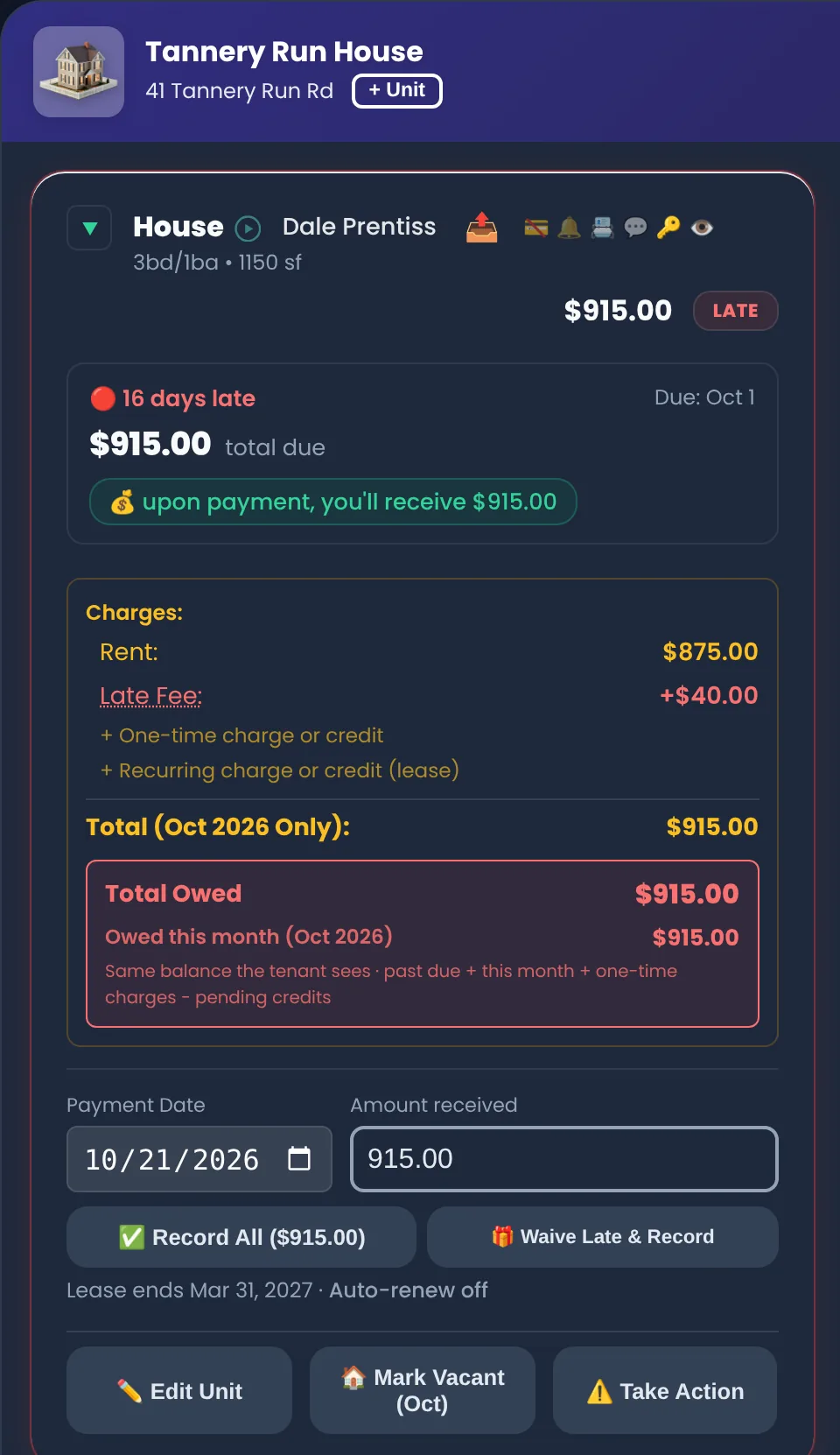
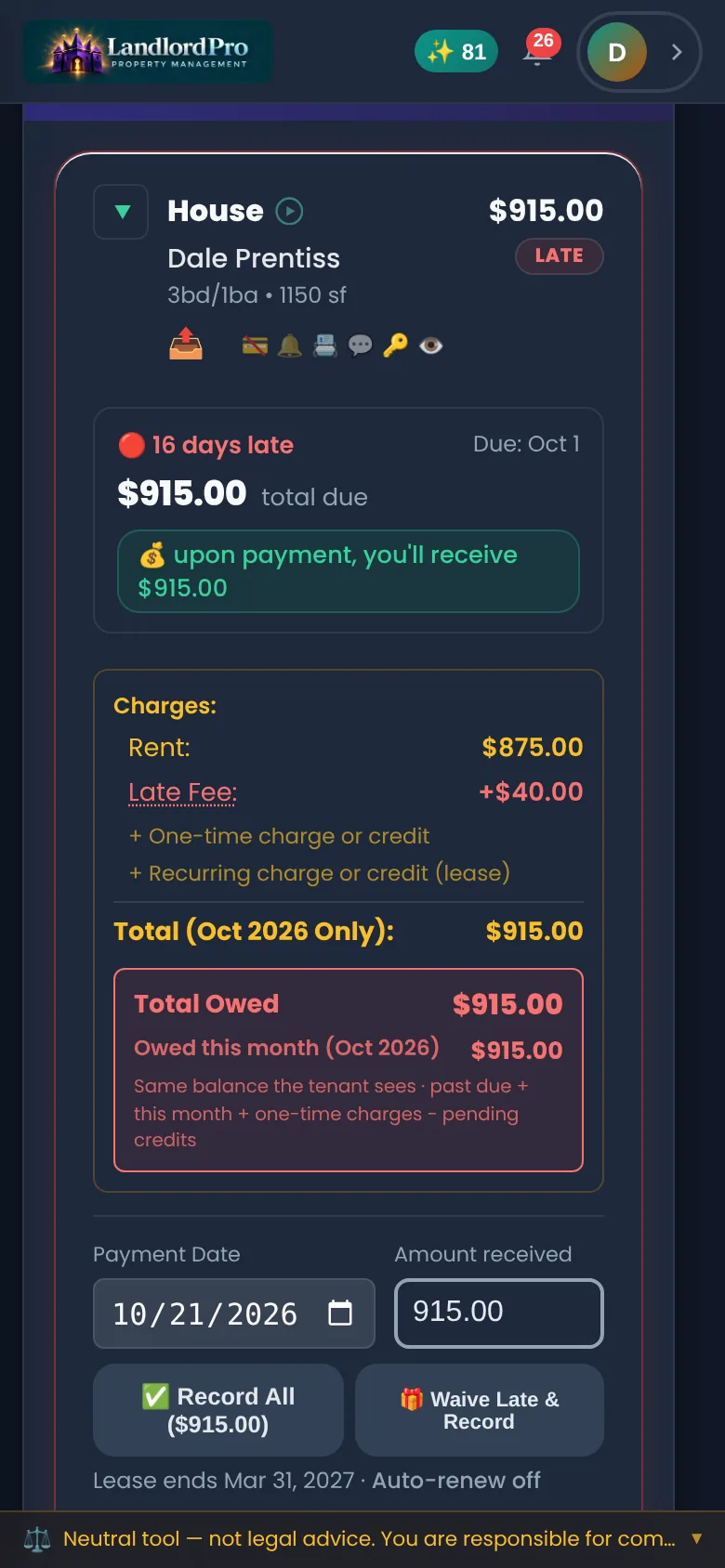
When I am angry, I round up. That is the first reason to slow down. Dale's card on the rent roll says exactly what he owes: $875 rent, the $40 late fee his lease allows, sixteen days late, $915 total. I did not type any of it. The lease says rent is due on the 1st with five days of grace and a $40 fee, and the roll did the arithmetic.
That number is going to be in every message, on the notice, and in front of the magistrate, so it has to be the same number everywhere. The card even says so at the bottom: same balance the tenant sees. If my number and the tenant's number ever disagree, I have handed him an argument I did not need to give him.
2Write to him, and let the silence go on the recordPro plan
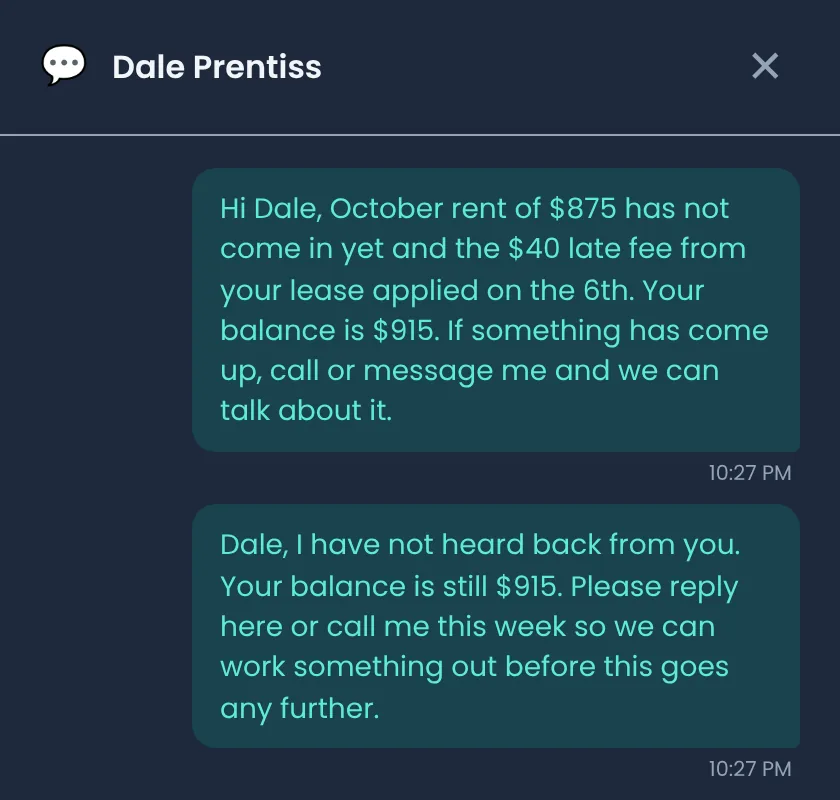
A tenant who stops answering is not a reason to stop writing. I send a plain message with the balance and an open door, and if that gets nothing, a second one that is a little firmer. No threats, no mention of locks or utilities, nothing I would not want read aloud in court, because it might be.
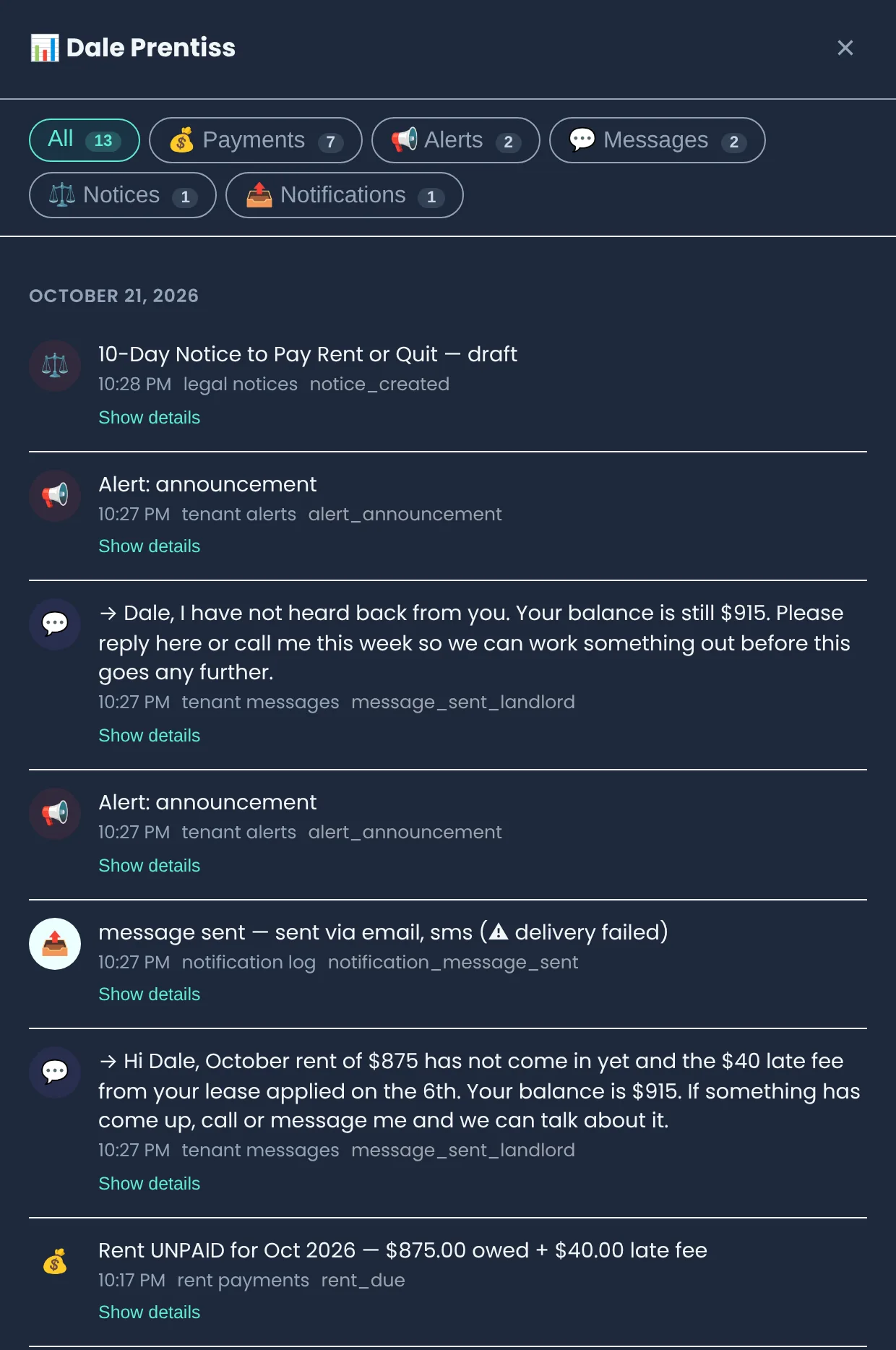
Every message sits in Dale's thread with the time I sent it. When a tenant opens a message in their portal, a Read mark shows up under it. Neither of these has one. That is not proof of anything by itself, but two dated, polite, unanswered messages are exactly what I want in the file when someone later says the landlord never reached out. Texts only go to tenants who have opted in to texts; everyone gets the portal copy.
3Serve the notice the law requires, drafted for my state, signed by mePro plan
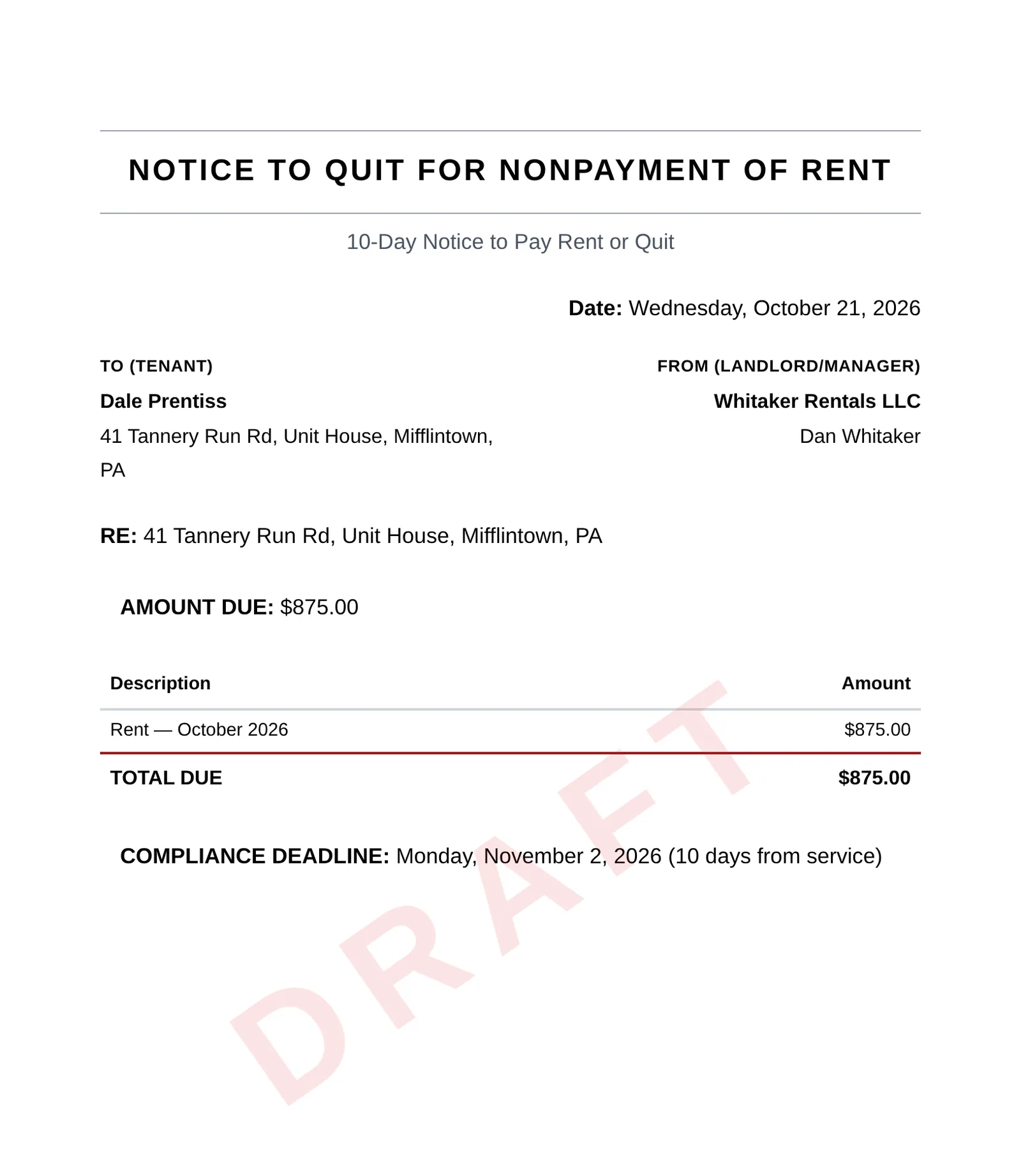
The legal path starts with a written notice, not a locksmith. In Notices & Actions I pick the situation, tenant didn't pay rent, then the formal pay or quit notice, and let the app fill it from my state's rules. For Pennsylvania the app uses a 10-day notice for nonpayment on a lease of a year or less, shows me the statute text it is reading from, and counts the deadline for me, moving it to the next business day when the tenth day lands on a weekend. Your state's period and rules are different; check your state's current law before you rely on any number.
By default the demand is the rent only, $875, and the late fee stays on Dale's account to collect separately, because a notice that demands something the lease does not clearly allow can be thrown out. It is a draft with DRAFT across it until I read it and sign it. I never serve one I have not read.
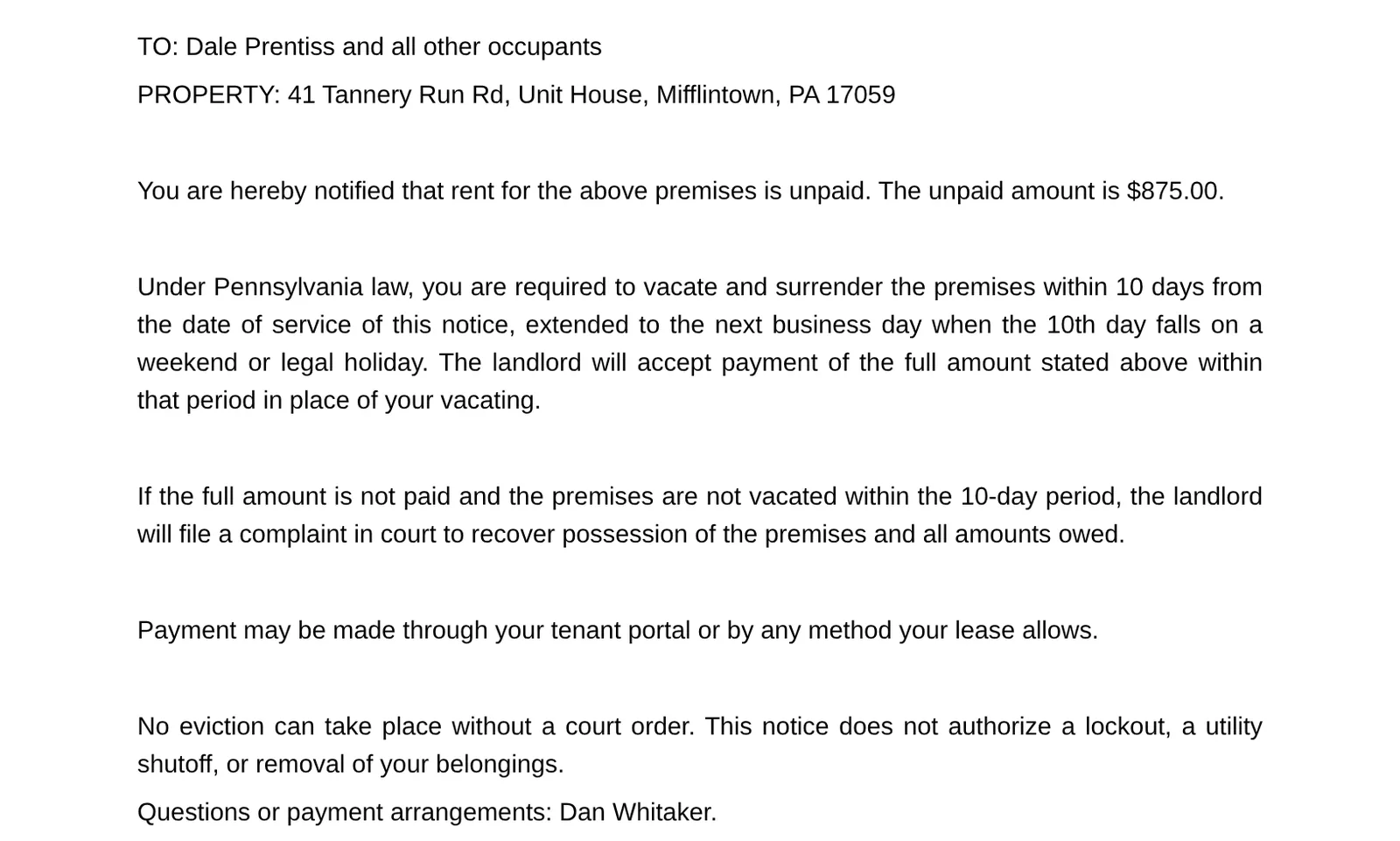
The second screenshot is the part that matters for this page. The notice itself tells the tenant, in plain words, that no eviction can happen without a court order and that the notice does not authorize a lockout, a utility shutoff or removing his things. I did not add that sentence. It is in the template, and it is a fair summary of the rule I am following.
For informational purposes only. This is not legal advice: LandlordPro is not a law firm and cannot interpret the law for you. Laws change, and cities and counties add their own rules. Verify the current statute yourself and consult a licensed attorney in your state before taking any legal action.
4The lock change is on the calendar. It is step eight, and a constable does itInvestor plan
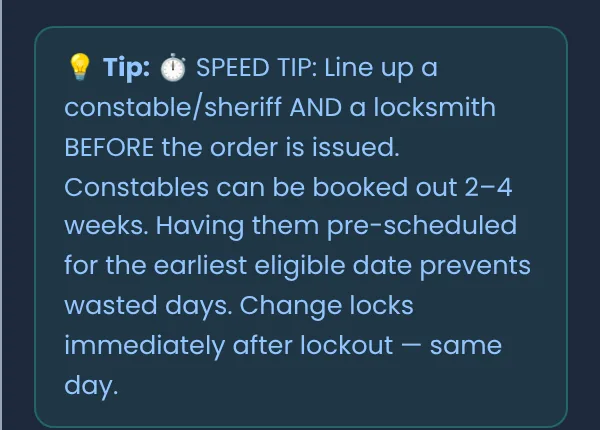
Here is the irony. The locks do get changed in the legal path. Just not by me, and not first. The eviction timeline lays out the whole sequence from the day of service: notice expires, file the complaint at the magistrate, hearing, judgment, order for possession, and then the lockout, carried out by a constable under a court order. Only after that does the app's tip say what I wanted to do on day one: change the locks the same day.
For Pennsylvania the app puts the lockout at about day 40 after service if every step happens at the legal minimum, and it says plainly that three months or more is realistic. That feels slow when the rent is not coming in. It is still faster than a self-help lockout, which tends to end with the tenant back inside, the clock reset and me paying for the privilege. The timeline is a guideline, not legal advice, and your state's steps and deadlines will differ.
What I use it for in practice is the list of things that reset the clock: taking a partial payment after serving, sloppy service, the wrong notice period. Those are the legal versions of the locksmith mistake, and they are spelled out on the side panel where I cannot miss them.
For informational purposes only. This is not legal advice: LandlordPro is not a law firm and cannot interpret the law for you. Laws change, and cities and counties add their own rules. Verify the current statute yourself and consult a licensed attorney in your state before taking any legal action.
5The file I hand the magistrateInvestor plan
Everything above wrote itself into Dale's record as it happened: the unpaid October rent with the late fee, both messages with their times, the delivery log, the draft notice. I did not keep a separate diary. The tenant records view shows it in date order, and it is the same story I would tell the judge, minus the part where I get worked up.
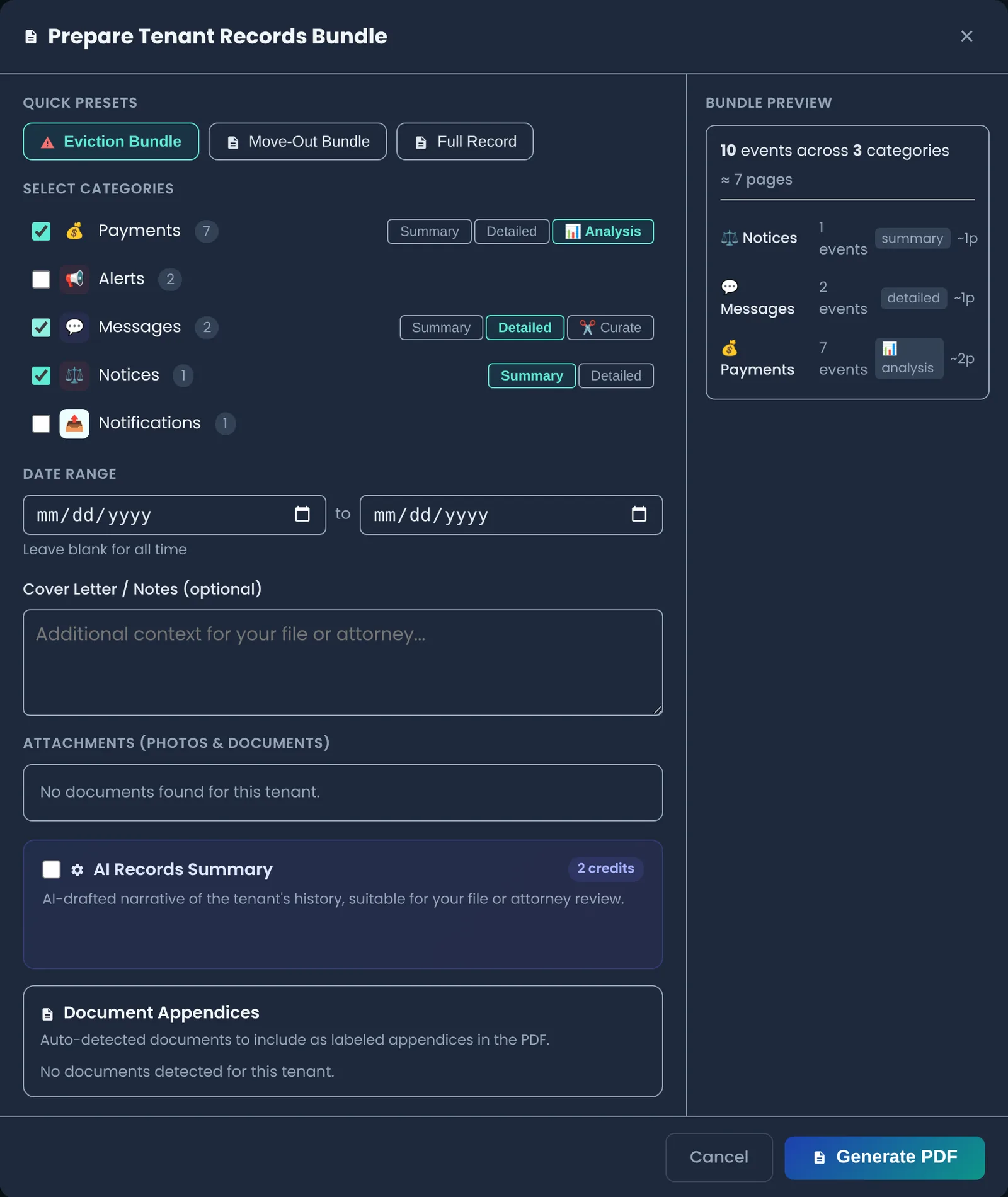
When it is time, Prepare Records Bundle with the Eviction Bundle preset turns that record into one PDF: the payment history with an analysis, the messages, the notice, a cover note if I want one, and a page count before I generate anything. A magistrate who gets a clean, dated file from the landlord and a story from the tenant tends to believe the file. A landlord who changed the locks has to explain that instead. It is a records tool, not legal advice, and I have handed the same bundle to an attorney and let them take it from there.
Why I take the slow road every time
The locksmith feels like control. It is the opposite. The moment a landlord changes the locks or kills the utilities without a court order, the dispute stops being about unpaid rent and starts being about what the landlord did, and the tenant gets to be the one with a complaint. The legal path keeps it about the rent, which is the one argument I am going to win.
Most tenants never get anywhere near day 40. A clear balance, a couple of dated messages and a properly served notice settle the large majority of these, often inside the notice period. When they do not, the file is already built and the dates are already on the calendar.
The rent roll and the late fee calculation are on every plan, including free. Messaging and notices are on the Pro plan; the eviction timeline and the records bundle are on Investor. None of it is legal advice, and in a messy case, a tenant who claims the unit is uninhabitable, or anything involving a lockout someone already did, I call an attorney first.
Questions landlords ask about this
Can a landlord change the locks if the tenant doesn't pay rent?
Not on their own. Changing the locks to force a tenant out without a court order is a self-help eviction, and it is illegal in essentially every state, even when the rent is months behind. The locks change after a court has ruled and the court's officer (a constable, sheriff or marshal, depending on the state) carries out the order for possession. Check your state's rules and talk to a local attorney before acting.
Can a landlord shut off the water, power or heat to get a tenant out?
No. Cutting off or interfering with utilities to pressure a tenant to leave is treated as a form of self-help eviction in essentially every state, and many states have specific penalties for it. If a utility genuinely has to be off for a repair, give the tenant proper notice of the work and the hours, and restore it promptly.
What is a self-help eviction?
Any attempt by a landlord to remove a tenant without going through the courts: changing the locks, removing doors or windows, shutting off utilities, taking or removing the tenant's belongings, or making the unit unlivable so they leave. The legal alternative is a written notice, a court case, a judgment, and a lockout carried out by a court officer.
What happens to a landlord who does an illegal eviction?
It depends on the state, but landlords can be ordered to let the tenant back in, made to pay the tenant's damages and sometimes extra statutory penalties and attorney fees, and can find the eviction case they would have won much harder to win. Some places also treat it as a criminal matter. Ask a local attorney what applies where your property is.
Can I remove a tenant's belongings if they stop paying?
No. Belongings stay where they are until a court has given you possession and the lockout has happened, and even then most states have abandoned-property rules: an inventory, a written notice and a waiting period before you can dispose of anything. Check your state's abandonment rules before touching anything.
What if the tenant seems to have left but did not tell me?
An apparently empty unit is a different situation, but it is also where landlords get caught. States have their own rules for deciding a unit is abandoned and what notice is required before you retake it. Document what you see, follow your state's abandonment process, and when in doubt, treat it as an occupied unit and go through the court.
Run your rentals the way this page shows
LandlordPro is free for up to 4 units — the rent roll, reminders, notices and the records bundle included. No card to start.
Start freeFor informational purposes only. This is not legal advice: LandlordPro is not a law firm and cannot interpret the law for you. Laws change, and cities and counties add their own rules. Verify the current statute yourself and consult a licensed attorney in your state before taking any legal action.