
My tenant wants to break the lease. Now what?
The phone rings on a Tuesday in October. The tenant in Unit A is five months into a twelve-month lease, her company is transferring her, and she is gone in two weeks. She is apologetic and she wants to know what she owes. Here is what I do, in order, and what it looks like in the software I built to do it.
I have run my own rentals in central Pennsylvania since 2020, thirteen units across three duplexes, a triplex and a quad. A tenant leaving early is not a disaster. Handled badly, it turns into one. The two mistakes I see landlords make are opposite ends of the same problem. One shakes hands on the phone, nothing goes in writing, and three months later nobody agrees on the last day, the last rent or what happened to the deposit. The other sends a bill for all seven remaining months, which feels fair and is usually the fastest way to lose: many states expect a landlord to make a real effort to re-rent the unit, and will not let you collect rent for months you could have filled.
The tenant on this page is a composite I will call Dana, and the screenshots are from a demo duplex in my own account, but every step is the one I take. The goal is simple. Agree on a clean exit, put it in writing, charge exactly what we agreed, get the unit back on the market before she is out the door, and make sure the numbers she sees are the numbers I see.
What I do, from the phone call to the next tenant
1Day 1: agree on the terms, put them in writing, then end the lease on the date we agreedPro plan
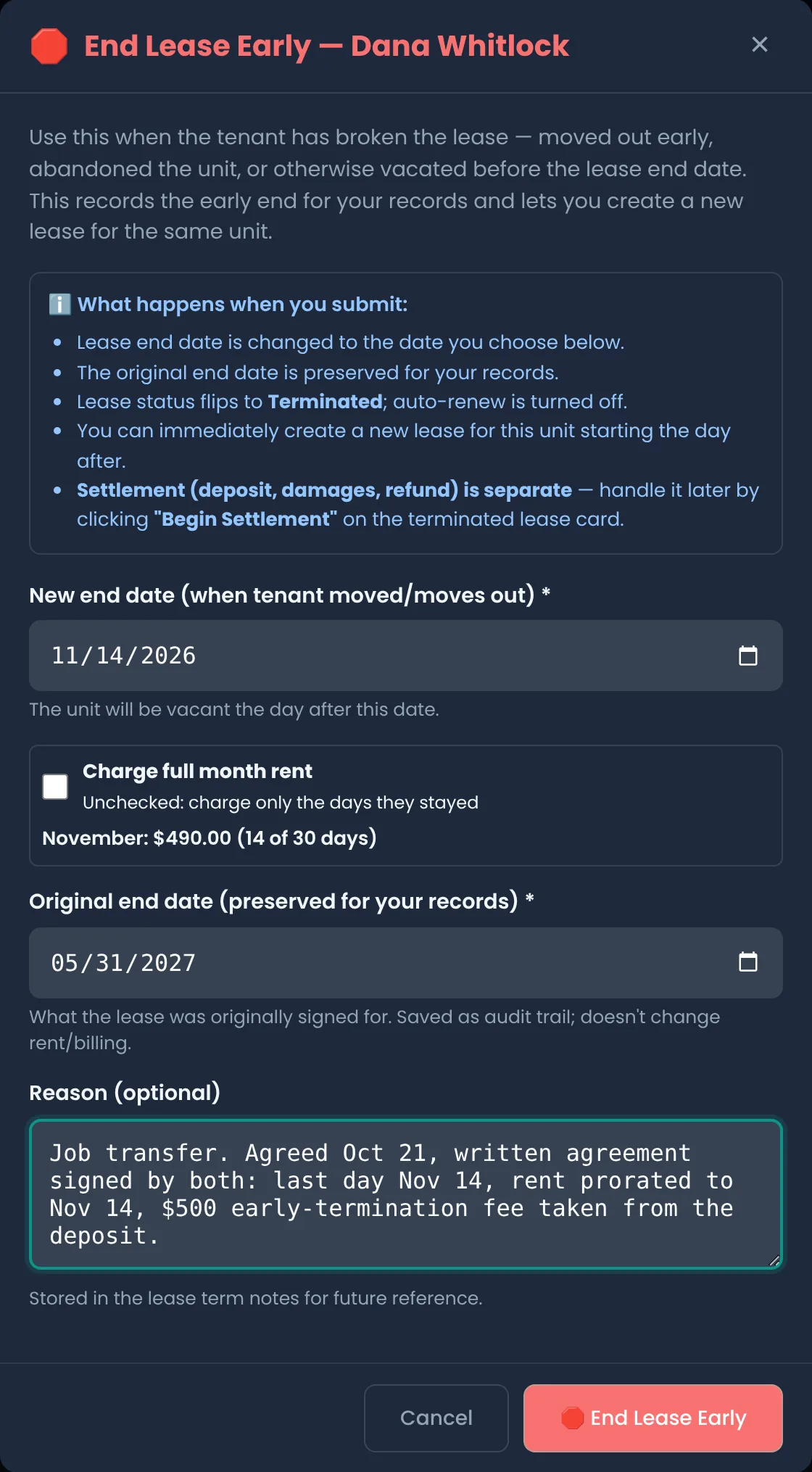
I do not agree to anything on that first call except a time to talk again. Before I call back I decide three things: the last day, whether the last month is full or prorated, and whether there is an early-termination fee. Dana and I settled on Friday, November 14 as her last day, rent for November prorated to the 14th, and a $500 fee for ending eight months early. Then it goes on paper, both of us sign it, and both of us keep a copy. A phone call is not an agreement. A signed page is.
Why not just bill her for the rest of the lease? Because in many states the law expects me to try to re-rent the unit, and I can usually only recover rent for the time it sits empty despite a real effort. A fair fee and a quick turnover beat a big bill I may never collect. Then I open End Lease Early in LandlordPro, enter November 14, uncheck the full-month box, and the app shows November at $490.00 for 14 of 30 days. The original end date, May 31, 2027, stays on the record, and the reason I type goes into the lease notes.
For informational purposes only. This is not legal advice: LandlordPro is not a law firm and cannot interpret the law for you. Laws change, and cities and counties add their own rules. Verify the current statute yourself and consult a licensed attorney in your state before taking any legal action.
2The last month: prorated to the day, with the deposit deadline in front of me
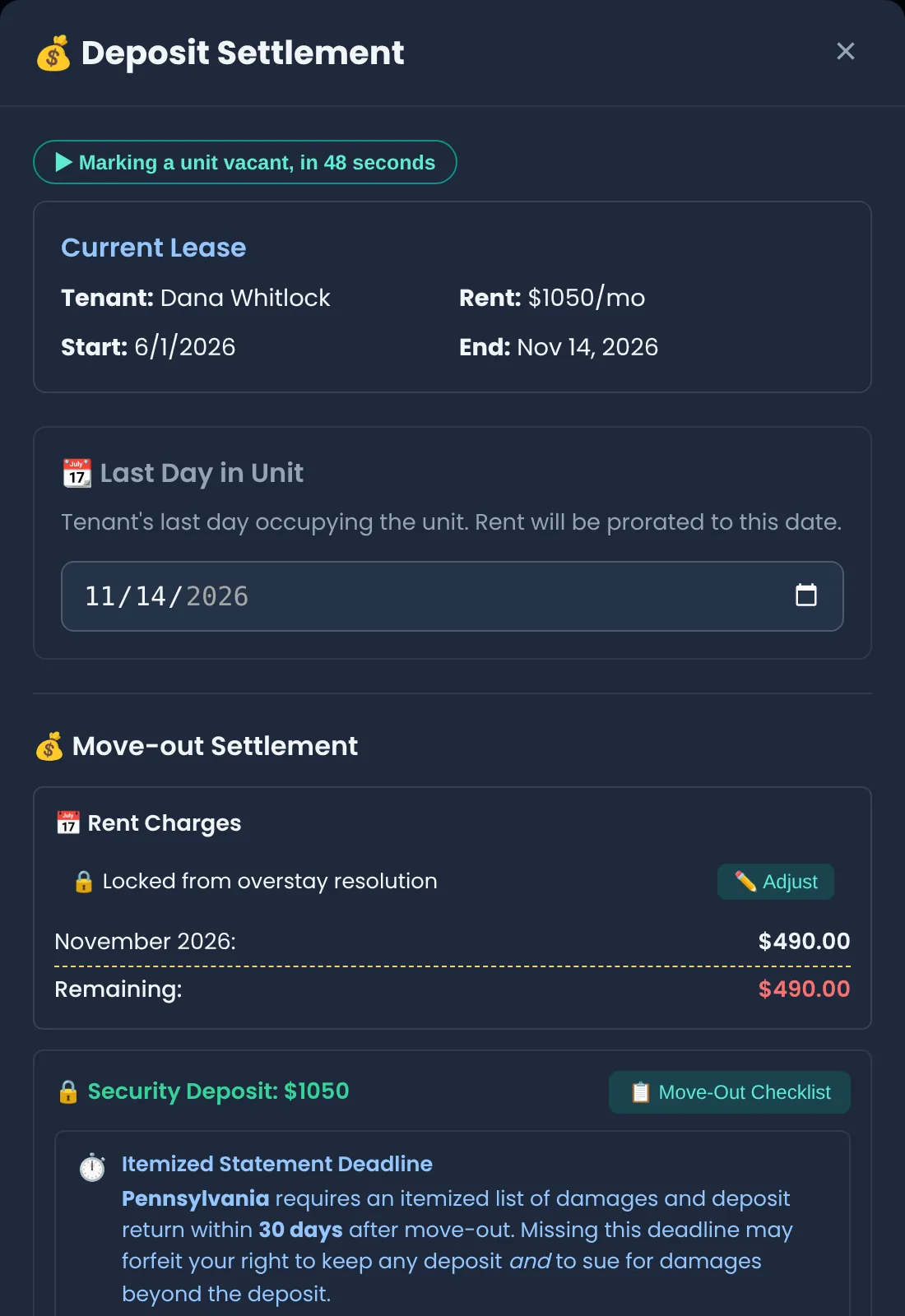
Once the end date is set, the terminated lease gets a Begin Settlement button. The settlement already knows the last day in the unit and the rent that goes with it: November 2026, $490.00. I did not divide anything by thirty. The deposit she paid, $1,050, sits right under it.
Under that is the line that keeps landlords out of small claims court: the deadline for the itemized deposit statement. In Pennsylvania the app uses 30 days from move-out, which puts it at December 14. Check your own state's current law, because the number and the penalties for missing it vary a lot. I do the walkthrough on the 14th and finish the settlement that week, not a month later.
For informational purposes only. This is not legal advice: LandlordPro is not a law firm and cannot interpret the law for you. Laws change, and cities and counties add their own rules. Verify the current statute yourself and consult a licensed attorney in your state before taking any legal action.
3The agreed fee comes out of the deposit as its own itemized line
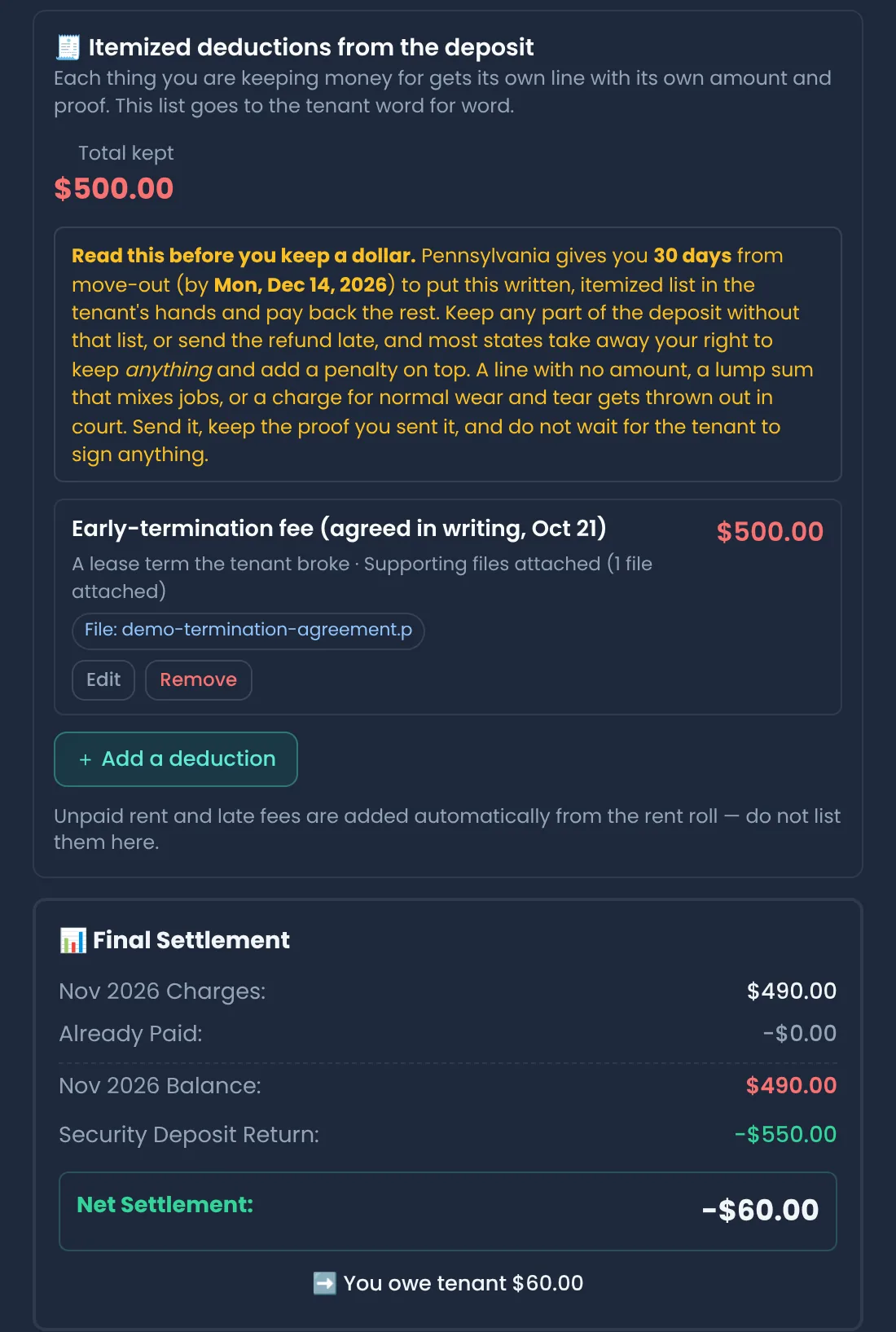
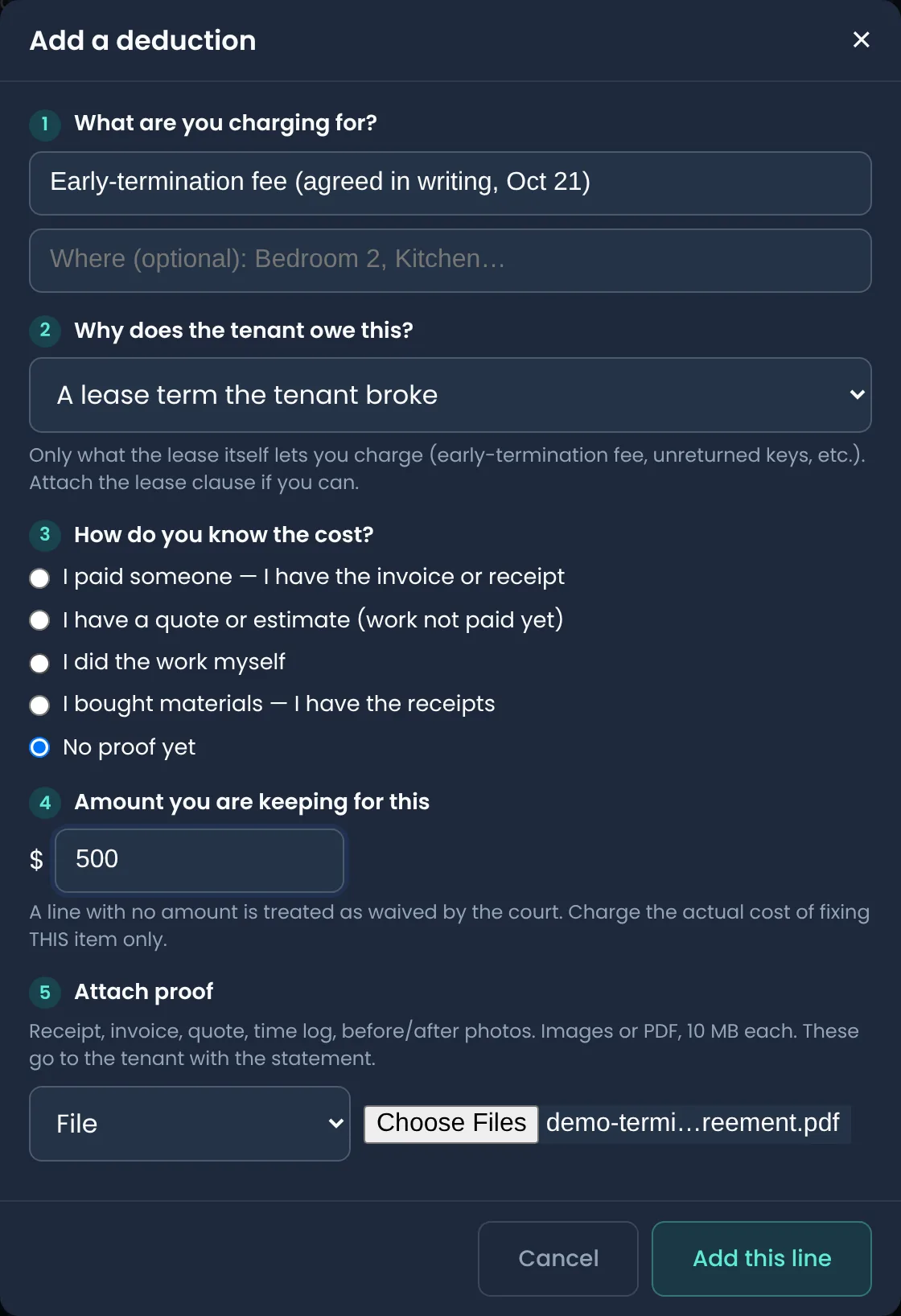
The $500 fee is one deduction with its own description, its own reason and its own amount. The reason I pick is A lease term the tenant broke, and the app's own note under it says it plainly: only what the lease itself lets you charge, such as an early-termination fee. Dana's lease had no early-termination clause, which is exactly why the fee is spelled out in the agreement we both signed, and I attach that agreement to the line. The statement goes to the tenant word for word, so the paper travels with it.
Then the arithmetic is done for me. $1,050 deposit, minus the $500 fee, leaves $550. If Dana pays her $490 for November on the 1st, the $550 goes back to her. If she does not, the settlement nets it against the deposit and shows I owe her $60.00. Either way there is no argument, because there is nothing to argue about: one fee, agreed, signed, itemized.
4The same week: the ad is written before she moves outpublishing is on the Starter plan
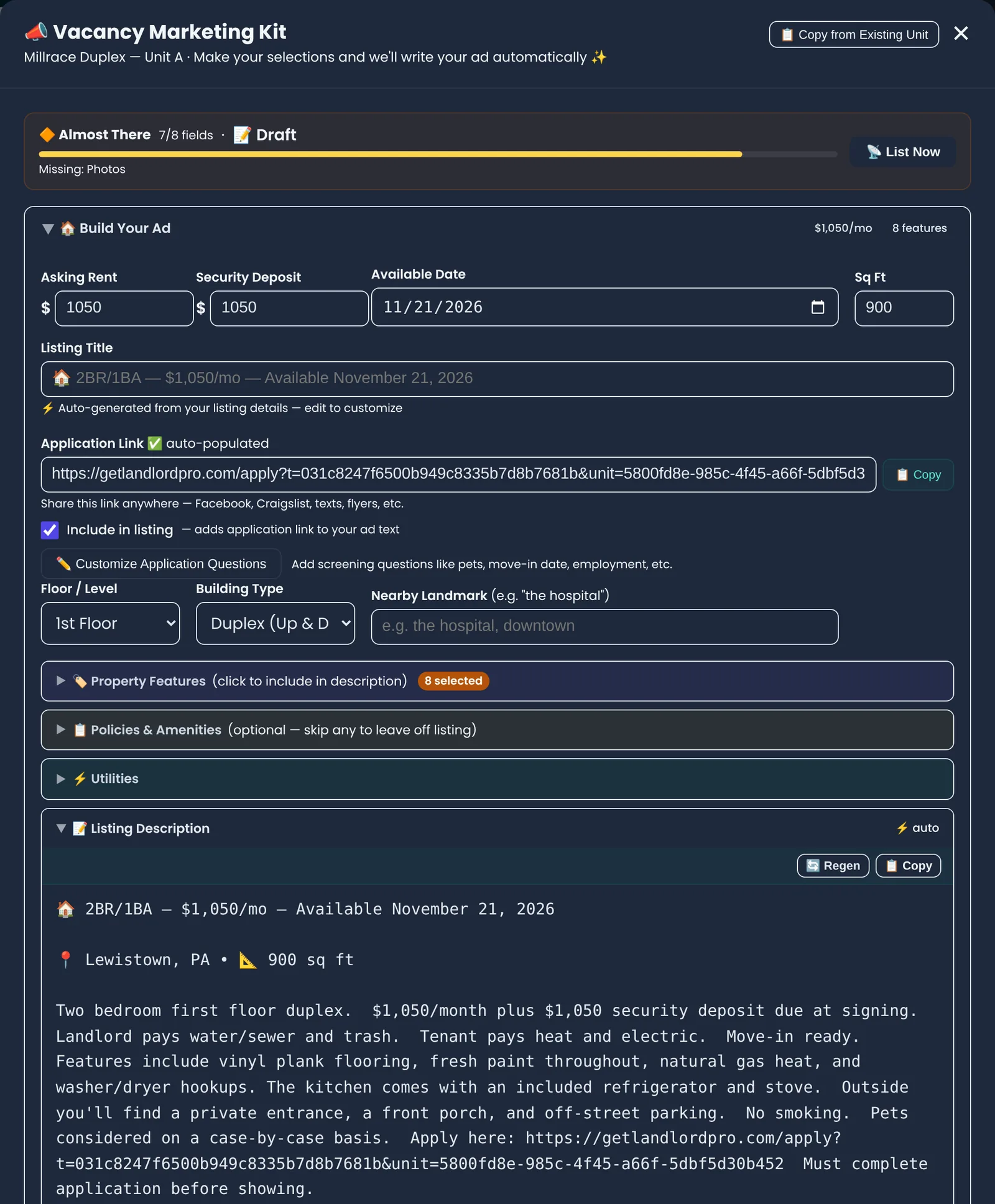
Re-renting fast is good business and, in many states, part of what the law expects of a landlord whose tenant leaves early. Keeping a record of when the unit went on the market is part of showing you tried. The day I record the early end, Unit A shows up on my Advertise list. I set the available date to November 21, a week after she leaves, which is my turnover window for paint and a deep clean.
The ad is built from clicks that describe the property: first-floor duplex, vinyl plank, fresh paint, gas heat, hookups, off-street parking, who pays which utility, no smoking, apply before showing. The description writes itself, with the price, the deposit, the application link and the equal housing line. It sits as a draft until I have photos. On December's rent roll, Unit A already shows vacant with no active lease, so nothing will bill Dana for a month she is not there.

For informational purposes only. This is not legal advice: LandlordPro is not a law firm and cannot interpret the law for you. Laws change, and cities and counties add their own rules. Verify the current statute yourself and consult a licensed attorney in your state before taking any legal action.
5Two sides of the same coin: my rent roll and her portal show the same last bill
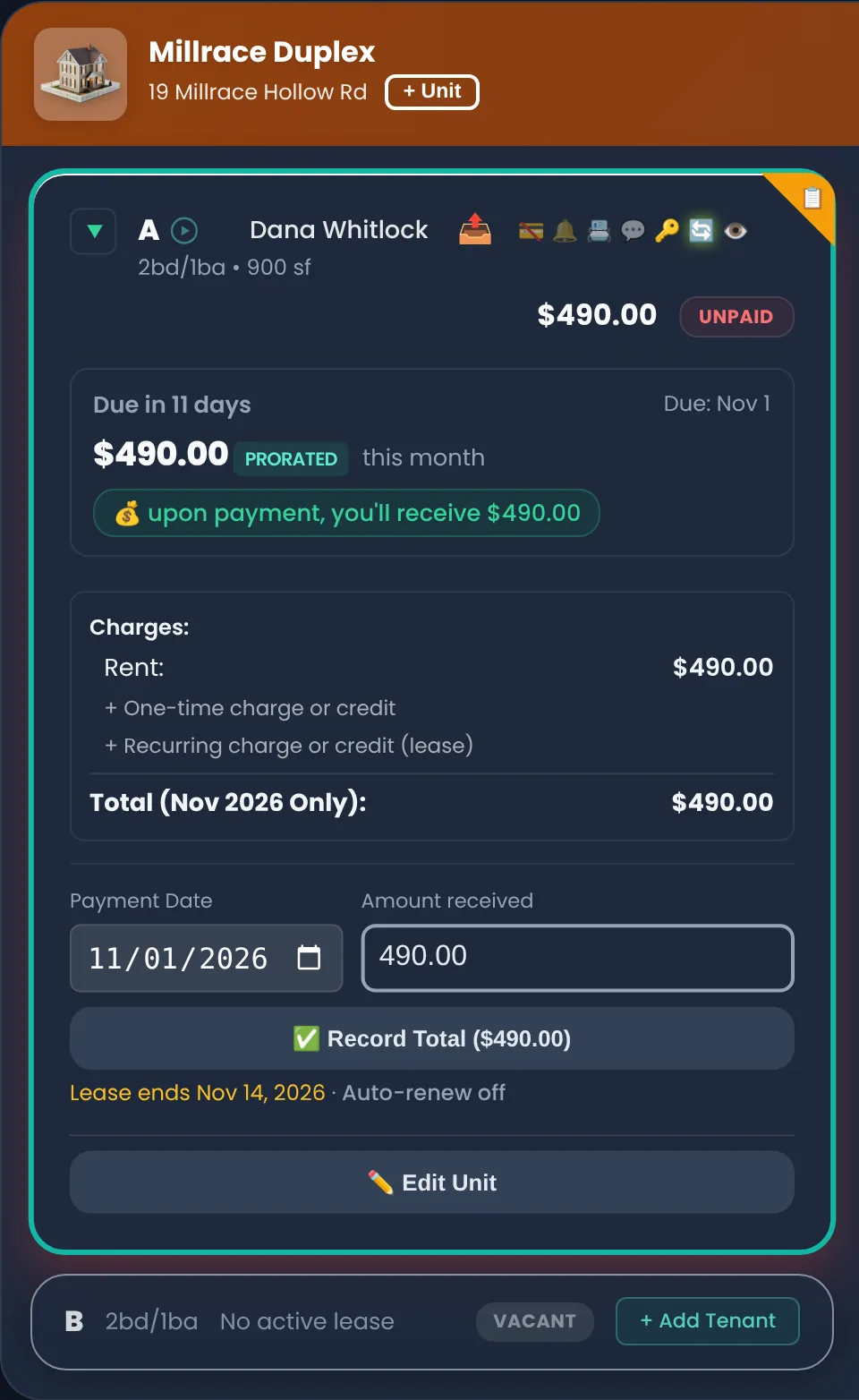
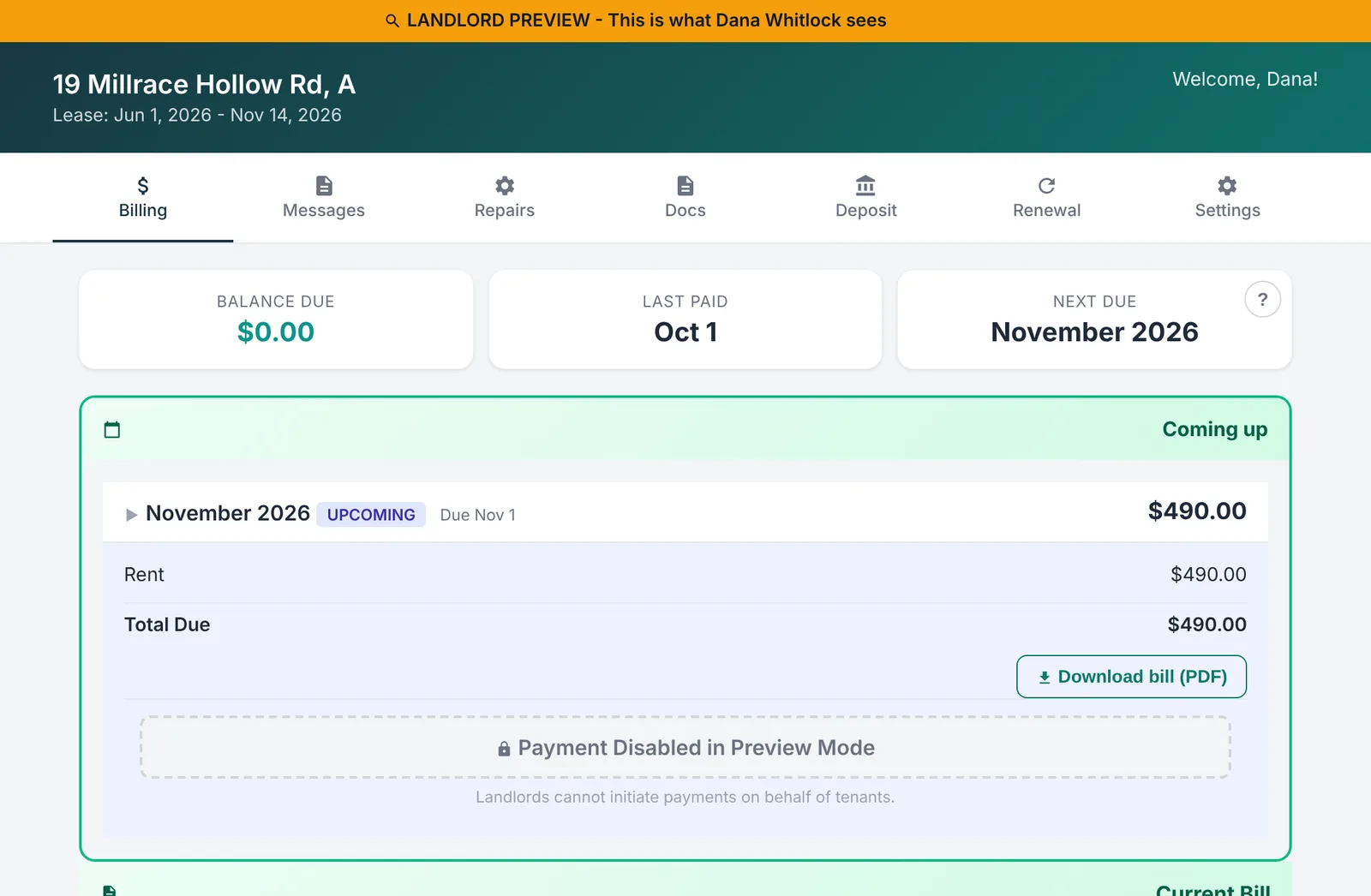
This is the part I check every time I change a lease, because a tenant who is already leaving is the one most likely to dispute a number. On my rent roll, Dana's November card says $490.00, PRORATED, due November 1, lease ends November 14. In her portal, which I can open from the card to see exactly what she sees, the same bill says $490.00 for November and her lease reads June 1, 2026 to November 14, 2026.
Same number, same dates, one calculation. When she pays, I record it on that card and her portal shows it paid, the same way it shows October. Nobody has to reconcile two spreadsheets or remember what was said on the phone in October.
What this looks like from her phone
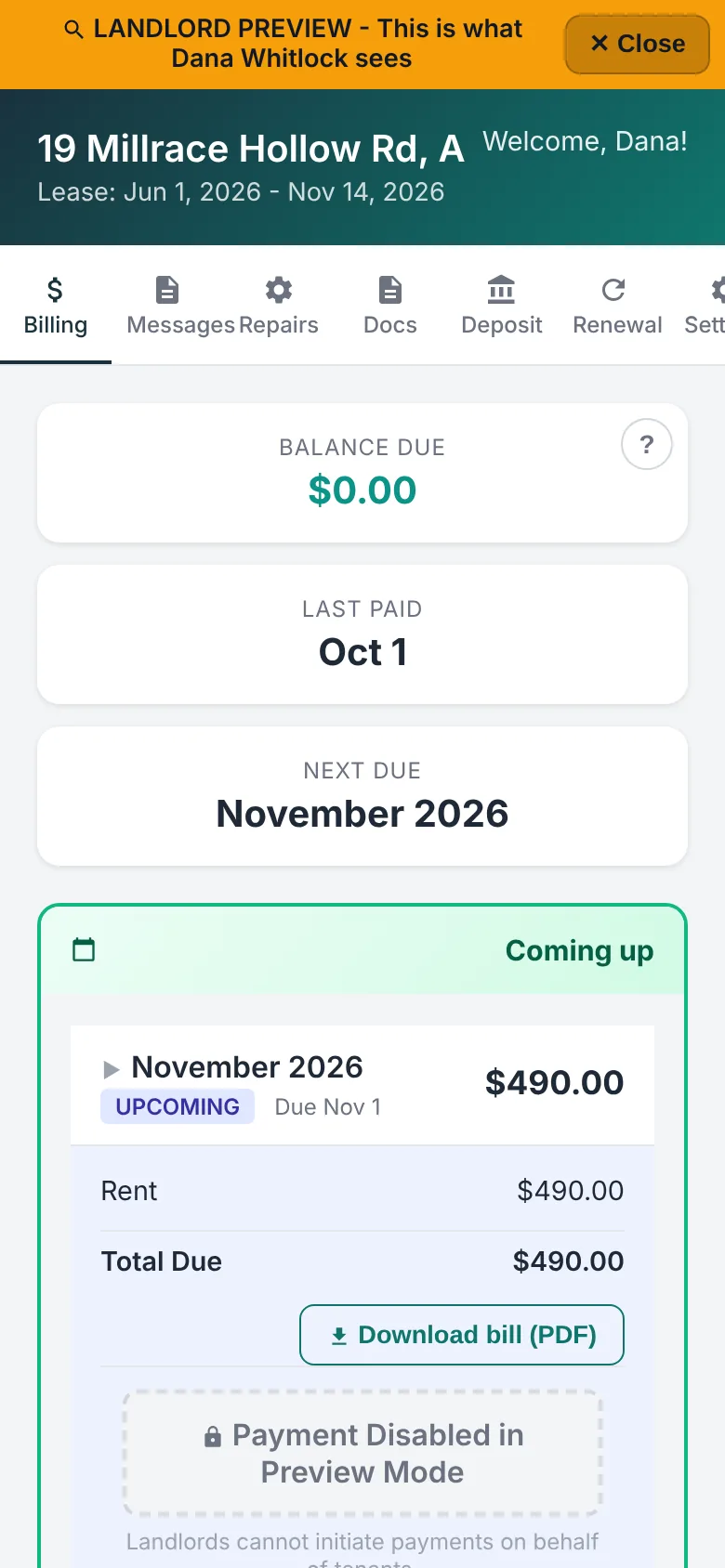
Dana checked her portal from her phone the night we signed. Her lease end date had already changed, and her last bill was the prorated number we agreed on. That is the whole point: a tenant who can see the deal in writing and in the numbers has no reason to call me about it.
If you take one thing from this page: a tenant who wants out is a negotiation, not a lawsuit. Agree on a clean exit, put it on paper, charge what you agreed, and get the ad written before the moving truck shows up. Ending a lease early in LandlordPro is on the Pro plan.
Questions landlords ask about this
Can a landlord charge rent after a tenant moves out early?
Usually the tenant is still responsible for rent under the lease, but many states require the landlord to make a reasonable effort to re-rent the unit, and limit what you can recover to the rent lost while it sat empty despite that effort, plus reasonable costs. Billing a tenant for every remaining month without trying to re-rent is risky. Rules vary by state, so check your state's law or ask a local attorney.
What is a typical lease break fee?
If your lease has an early-termination clause, the fee in that clause is the starting point. Without one, it is a negotiation: many landlords ask for something in the range of one or two months' rent in exchange for releasing the tenant, and put the deal in a signed agreement. Some states regulate these fees, so check your state before you write one into a lease.
Do I have to let a tenant out of the lease early?
Usually not, unless the lease allows it or the law gives the tenant a right to leave. Tenants with active-duty military orders, and in many states victims of domestic violence, can have a legal right to end a lease early. Check your state's rules, and when in doubt ask a local attorney before you refuse.
Can I keep the security deposit if a tenant breaks the lease?
Only for amounts the lease, a signed agreement and your state's law allow, and only with a written, itemized statement sent within your state's deadline. In LandlordPro each deduction is its own line with an amount and proof, and the settlement shows the deadline the app uses for your state (30 days from move-out in Pennsylvania). Check your state's current law.
What should an early lease termination agreement include?
The tenant's last day, how the final month's rent is handled (full or prorated), any early-termination fee and how it is paid, how the security deposit will be handled, when keys come back and what condition the unit should be in, and both signatures with the date. Each party keeps a copy.
How do I prorate the last month's rent?
The common method is monthly rent divided by the days in that month, times the days the tenant stays. For a $1,050 rent and a last day of November 14, that is 14 of 30 days, or $490. Some leases set a different daily rate, so follow your lease. LandlordPro prorates the final month automatically when you set the early end date, and the free prorated rent calculator does the same math.
Run your rentals the way this page shows
LandlordPro is free for up to 4 units — the rent roll, reminders, notices and the records bundle included. No card to start.
Start freeFor informational purposes only. This is not legal advice: LandlordPro is not a law firm and cannot interpret the law for you. Laws change, and cities and counties add their own rules. Verify the current statute yourself and consult a licensed attorney in your state before taking any legal action.