
How much can I charge for a late fee?
Somebody hands you a lease template and it says $100 if the rent is late. It sounds reasonable. In some states it is more than the law allows, and a fee the law does not allow is a fee a magistrate will not let you collect. Here is how I pick the number, and how I make sure it gets charged exactly as written.
I have run my own rentals in central Pennsylvania since 2020, thirteen units across three duplexes, a triplex and a quad. The late fee is the smallest number in the lease and it causes more arguments than the rent. The fee was copied from a form written for another state. It went on a day early. It was in the landlord's head but not in the lease. The tenant was charged $100 one month and $50 the next because the landlord did the math in a hurry. Every one of those is a fee you can lose at the magistrate, and some of them can cost you the whole case.
So the fee gets decided once, on purpose, before the lease is signed, and after that nobody does any math by hand. The tenant on this page is a composite I will call Dale, and the screenshots are from a demo single-family house in my own account, but the steps are the ones I take on every lease.
What I do, from picking the number to the day it is charged
1Before I write a number: what my state's entry says
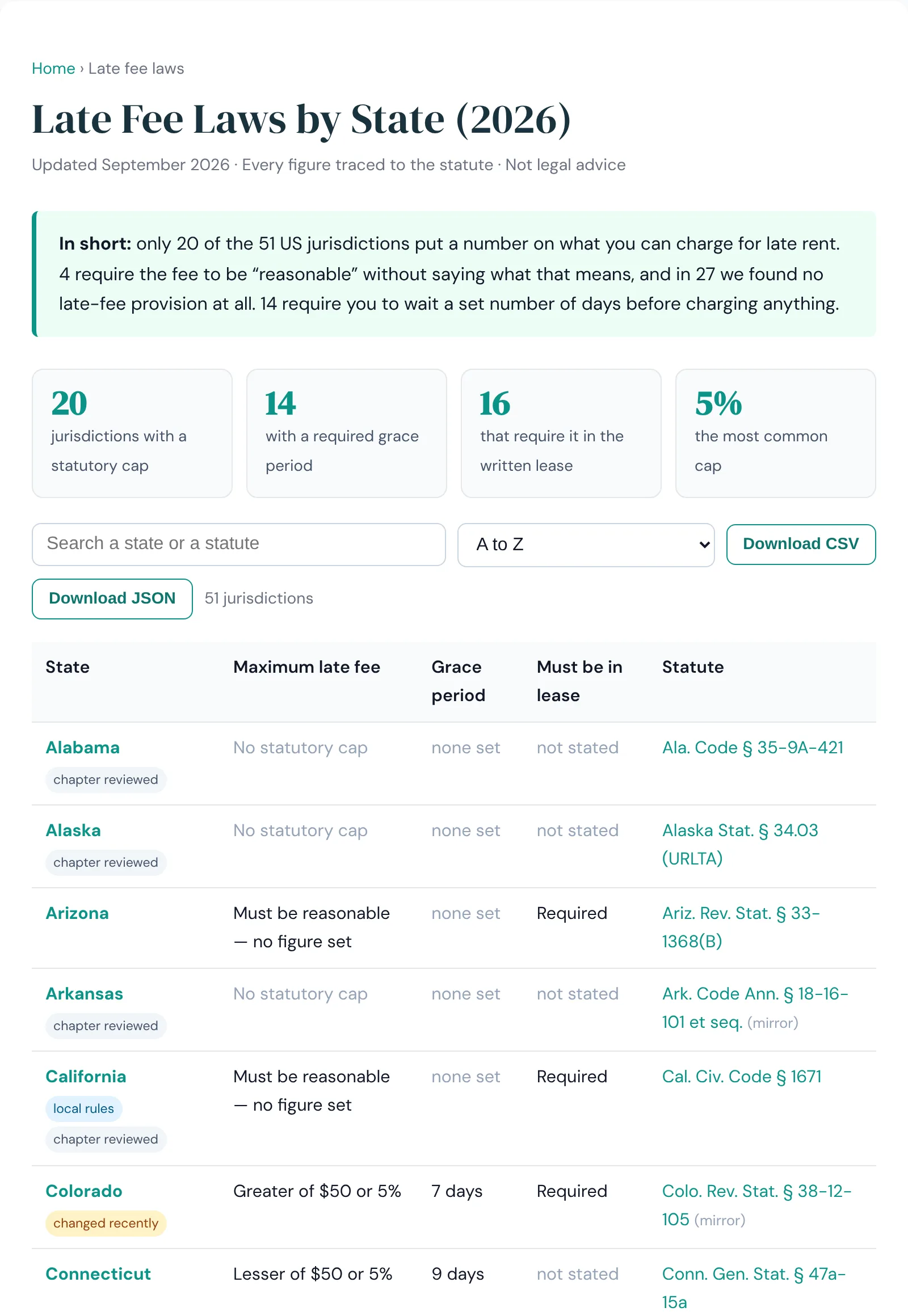
The first thing I look at is not the template, it is the state. The LandlordPro late fee table lists all 51 jurisdictions with the maximum fee, the grace period, whether the fee has to be in the written lease, and the statute each figure was read from. The summary at the top is the part that surprises people: only 20 of the 51 put a number on it, and 14 make you wait a set number of days before you can charge anything. Two states can use the same two figures and land on opposite answers. Colorado's row says the greater of $50 or 5%; Connecticut's says the lesser.
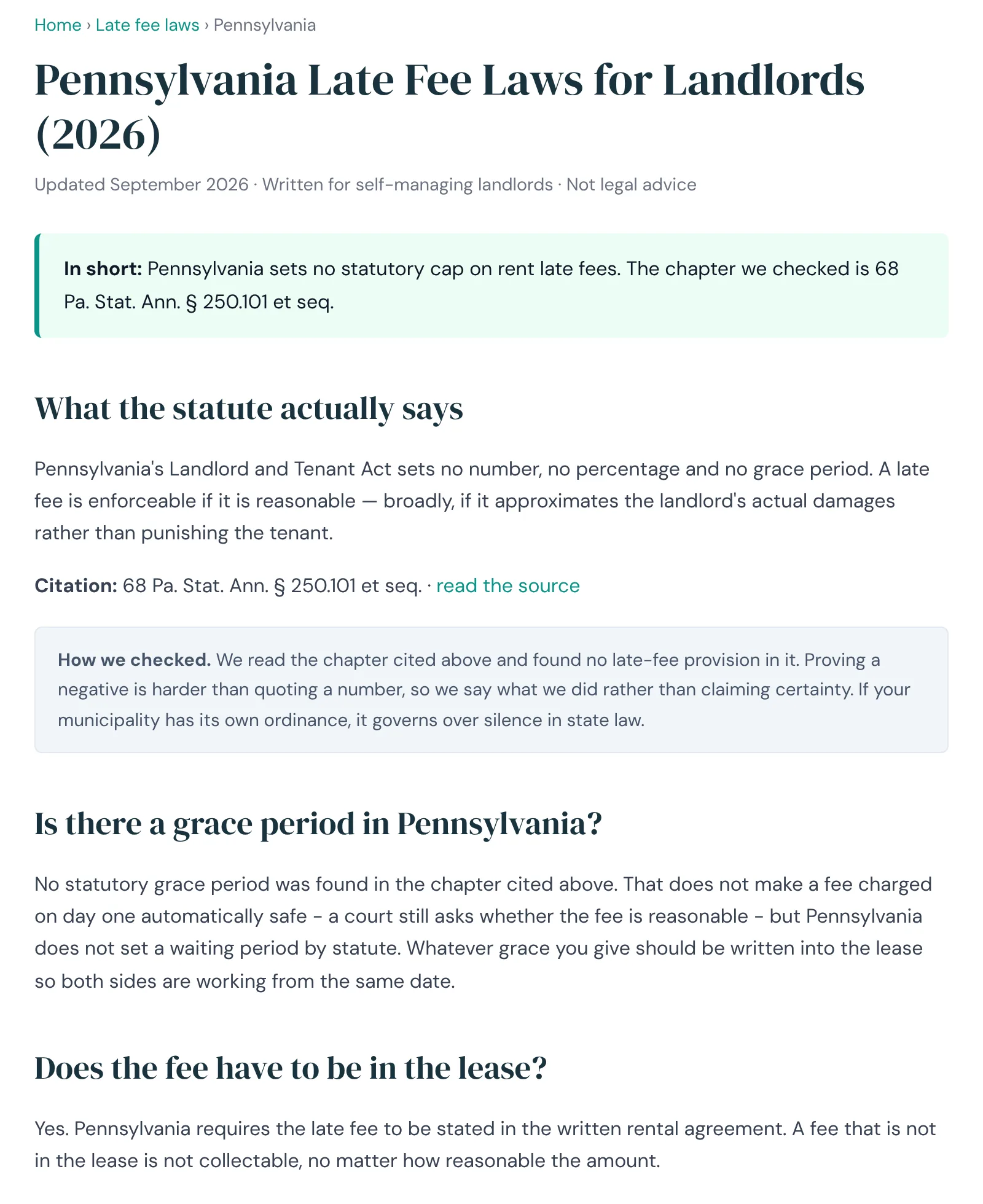
My rentals are in Pennsylvania. The app's Pennsylvania entry says there is no statutory cap and no statutory grace period, that the fee has to be reasonable, and that it has to be written into the lease or it is not collectable. That is why my leases say $50 after five days and not $100 on day two. Your state's number may be different and laws change, so check your state's current law before you rely on any table, including mine.
For informational purposes only. This is not legal advice: LandlordPro is not a law firm and cannot interpret the law for you. Laws change, and cities and counties add their own rules. Verify the current statute yourself and consult a licensed attorney in your state before taking any legal action.
2Running the template's $100 through the calculator
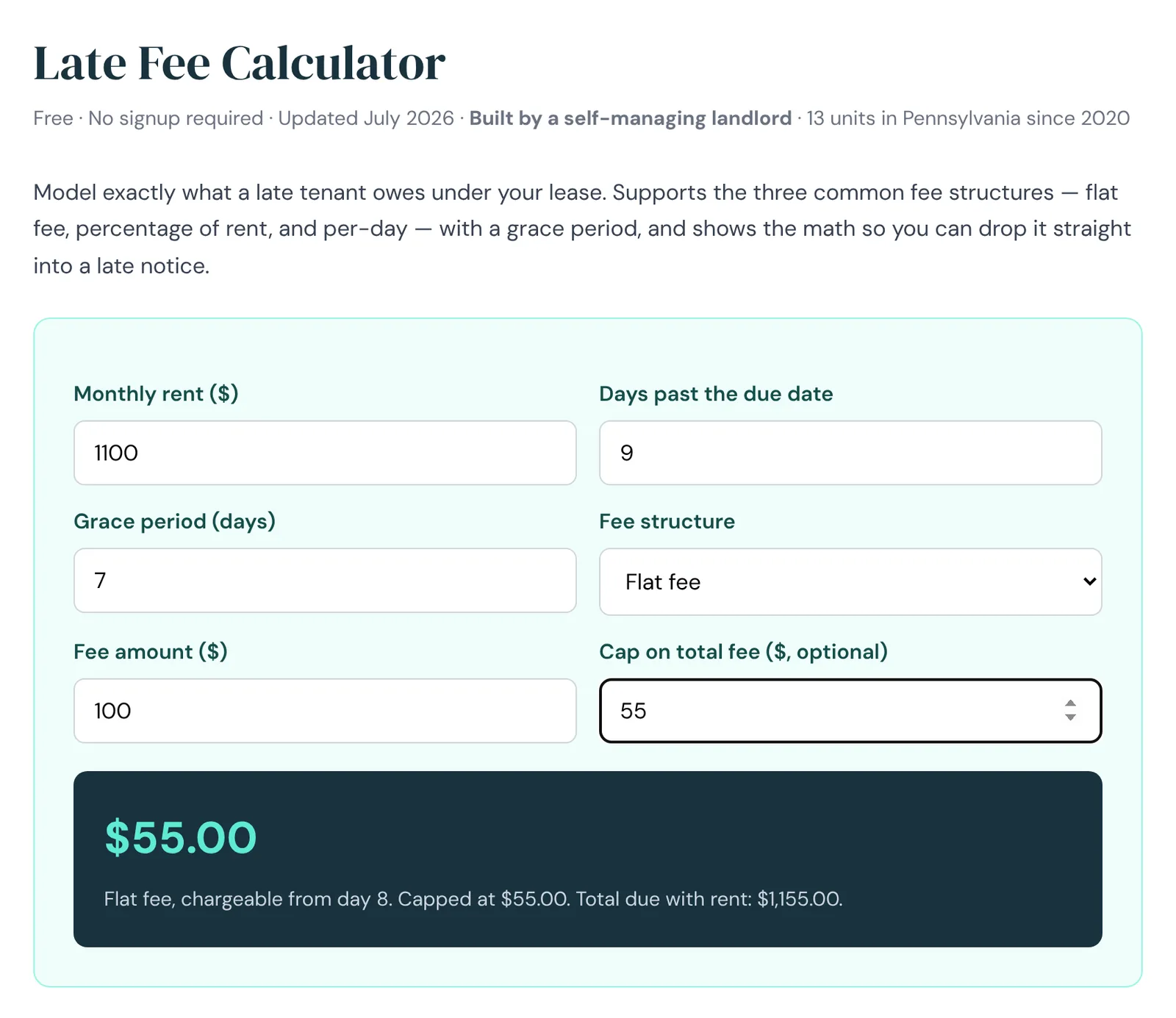
When a landlord tells me their template says $100, I put it in the late fee calculator with them. It takes the rent, the days late, the grace period and the fee as a flat amount, a percentage of rent or a per-day charge, and it shows the fee, the first day it can be charged and the total owed. It does not need an account.
Here is the same $100 on $1,100 rent if the house were in Colorado instead of Pennsylvania. The table's Colorado row says the greater of $50 or 5% and a 7-day wait, so the cap is $55 and the grace period is 7. The calculator says $55, chargeable from day 8. The template's $100 is $45 over and four days early. The calculator does not look up the state for you; the number in the cap box is the one you read in step one, from your state's current law.
For informational purposes only. This is not legal advice: LandlordPro is not a law firm and cannot interpret the law for you. Laws change, and cities and counties add their own rules. Verify the current statute yourself and consult a licensed attorney in your state before taking any legal action.
3The fee goes into the lease once, in the lease wizard
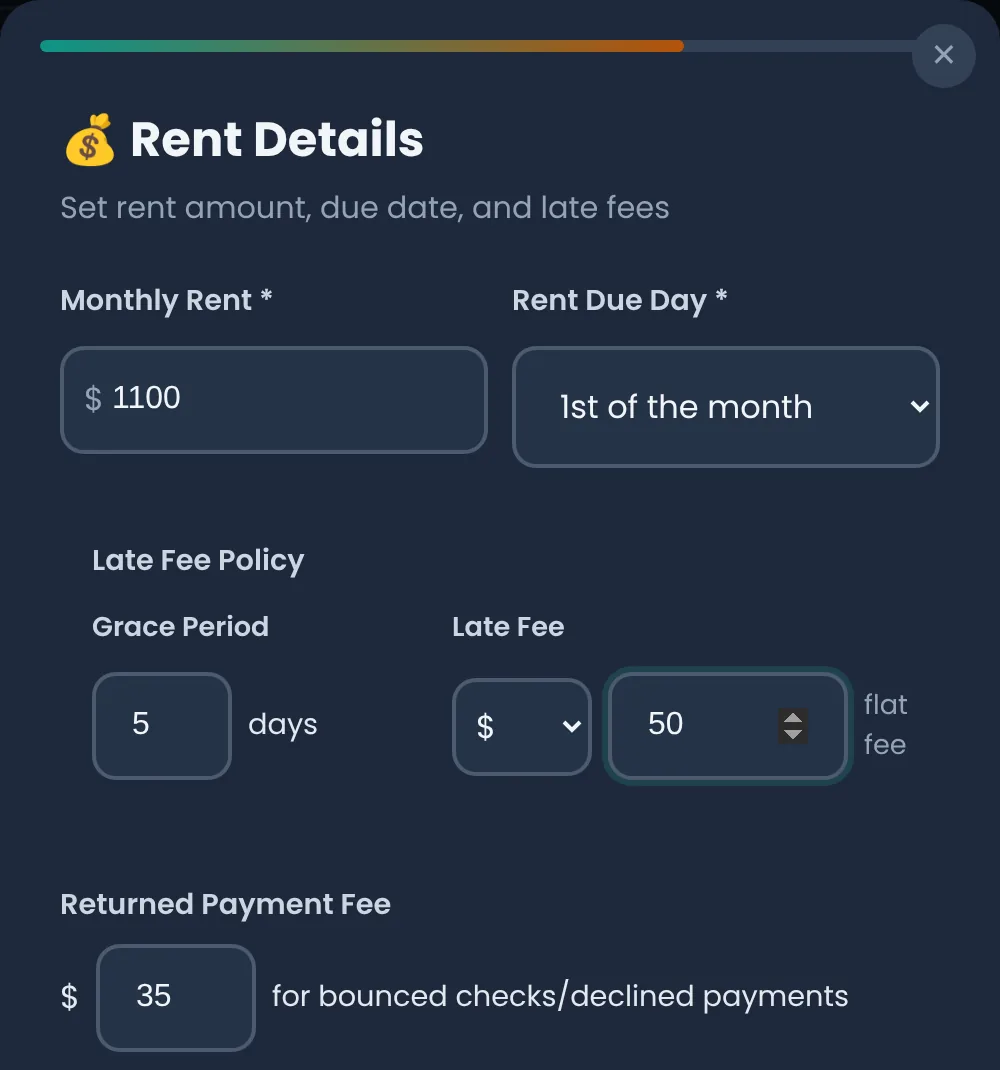
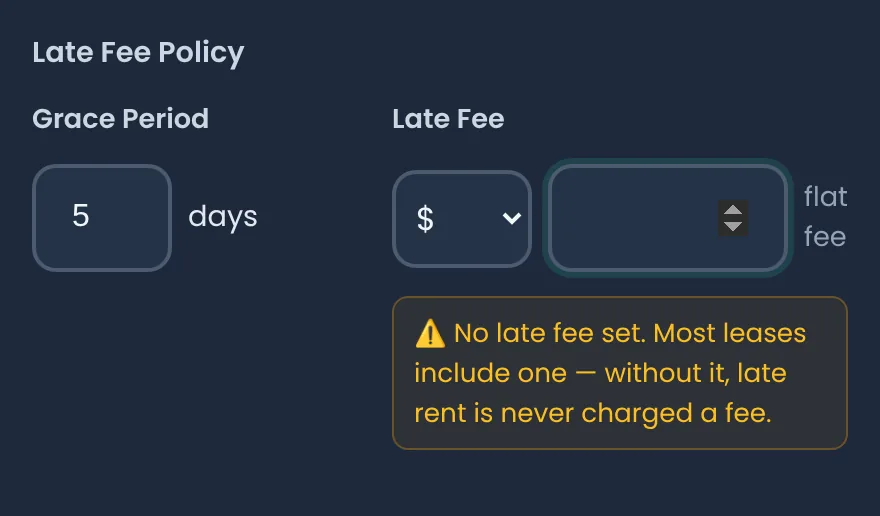
Dale's lease is $1,100 due on the 1st. In the lease wizard the Late Fee Policy is two boxes: the grace period in days, and the fee, either a flat dollar amount or a percentage of rent. I put 5 days and $50 flat. Those two numbers are now the late fee for this lease, for every month of it, and everything downstream reads them from here.
If I leave the fee blank, the wizard tells me in yellow that late rent will never be charged a fee. That warning is right. A fee that is not in the lease is not a fee you can add later in the middle of a tenancy, so this is the moment to decide. The wizard takes whatever number I give it, so picking a legal one is my job, and that is why the first two steps come first.
4After the grace period, the rent roll adds the fee by itself
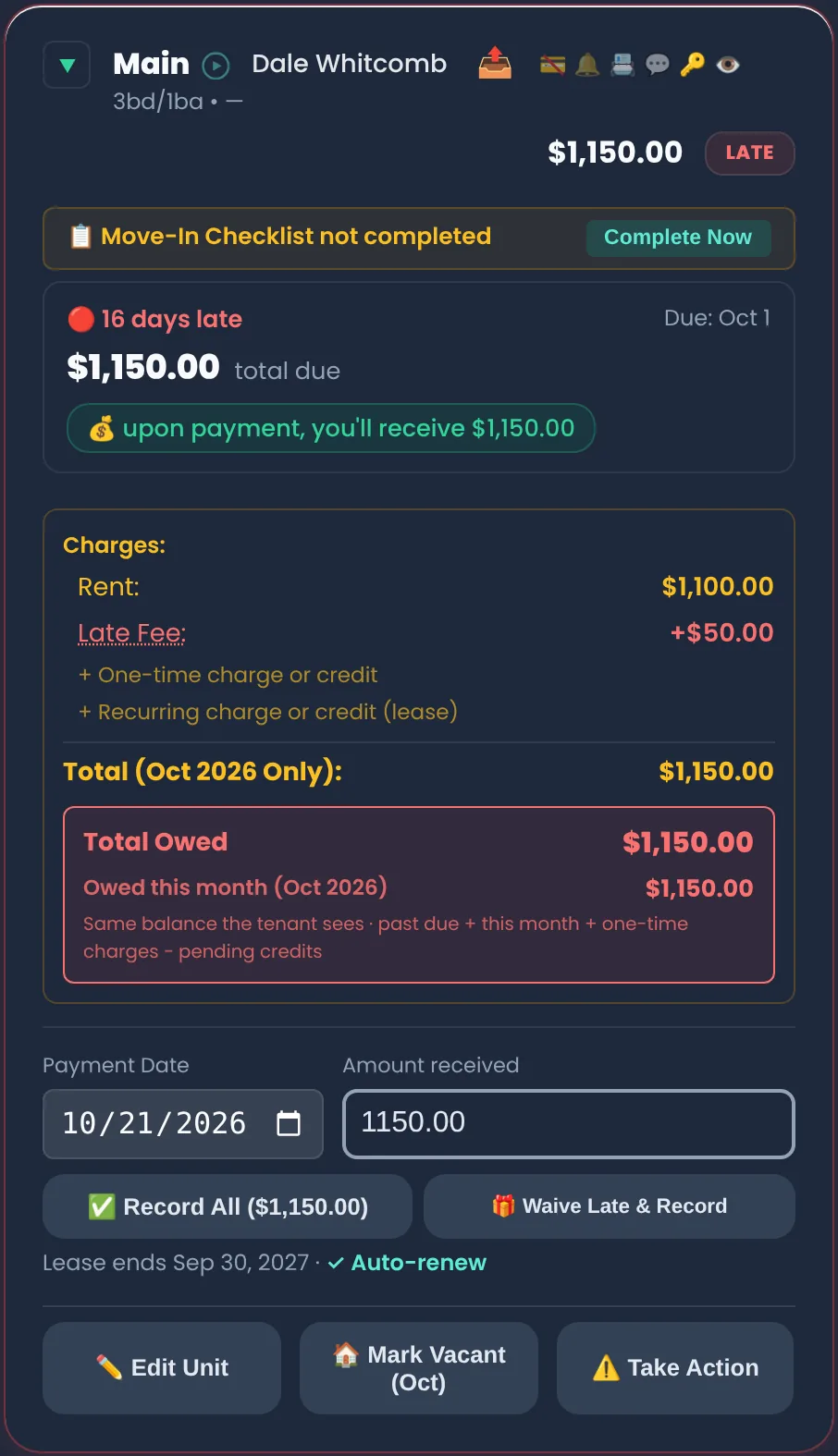
I do not add late fees. Once the grace period in Dale's lease has run out and no rent has been recorded, his card on the rent roll flips to LATE and the fee from his lease goes on under Charges: rent $1,100, late fee $50, total owed $1,150. Hover the words Late Fee and it says $50.00 flat fee, which is the rule it came from. A lease with no fee in it gets no fee, which is exactly what the wizard warned about.
That matters more with thirteen leases than with one. They were not all written the same year and they do not all say the same thing, and I want each one charged exactly as written, not the way I remember it. When I do decide to give a tenant a break, there is a Waive Late & Record button, so the waiver is a recorded choice and not a number I quietly left off.
5The tenant sees the same fee, on the same line
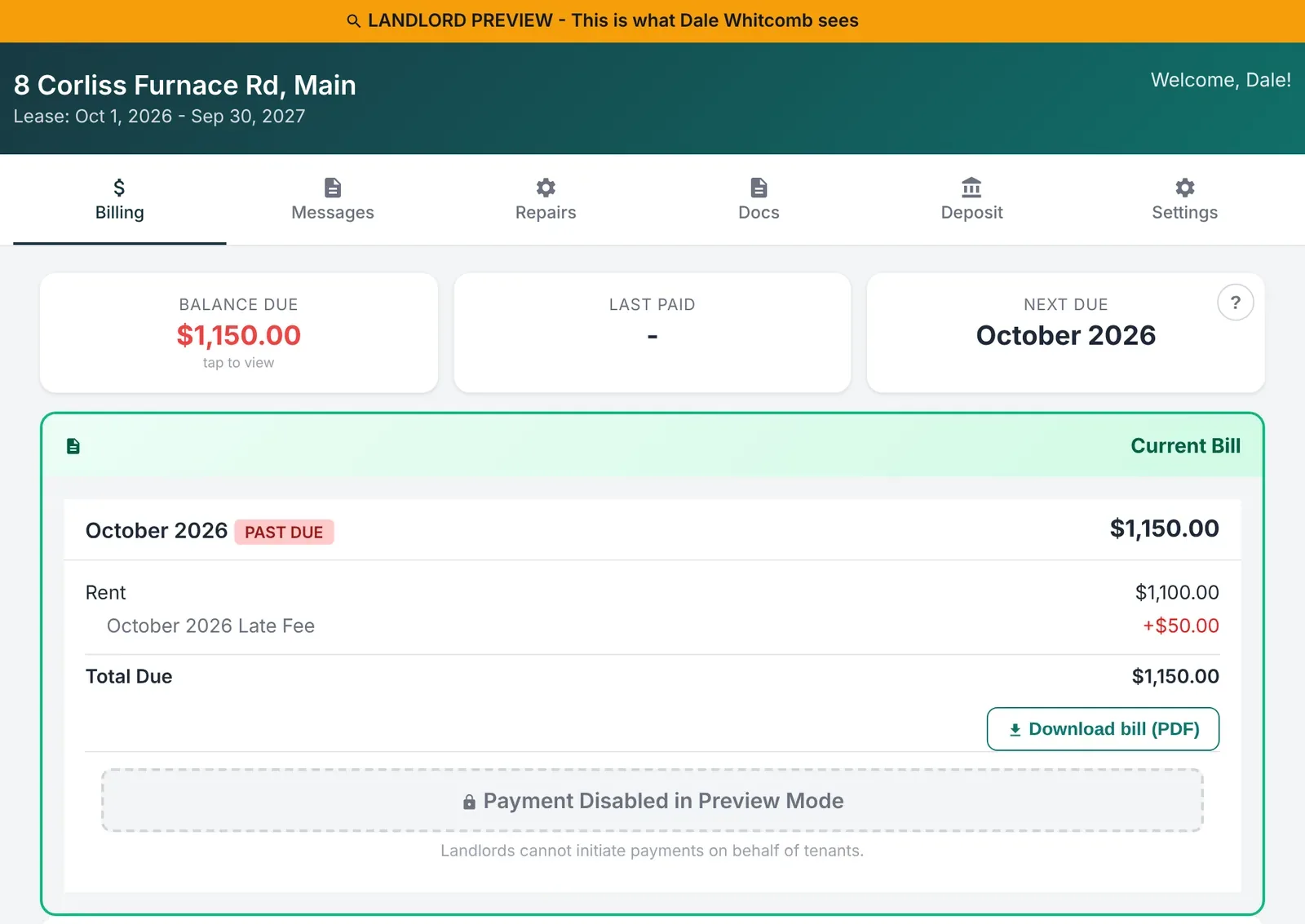
The other half of a late fee is the tenant knowing about it before it turns into an argument. Dale's portal shows his October bill the way my rent roll does: rent $1,100, an October late fee of $50 on its own line, total due $1,150, marked past due. There is a button to download it as a PDF. This screenshot is the landlord preview, which is why the pay button is switched off.
There is one balance, and both of us are looking at it. My card even says so under the total: same balance the tenant sees. When a tenant tells me they did not know about the fee, the answer is in their own portal, dated, matching the lease they signed.
What the tenant sees on a phone
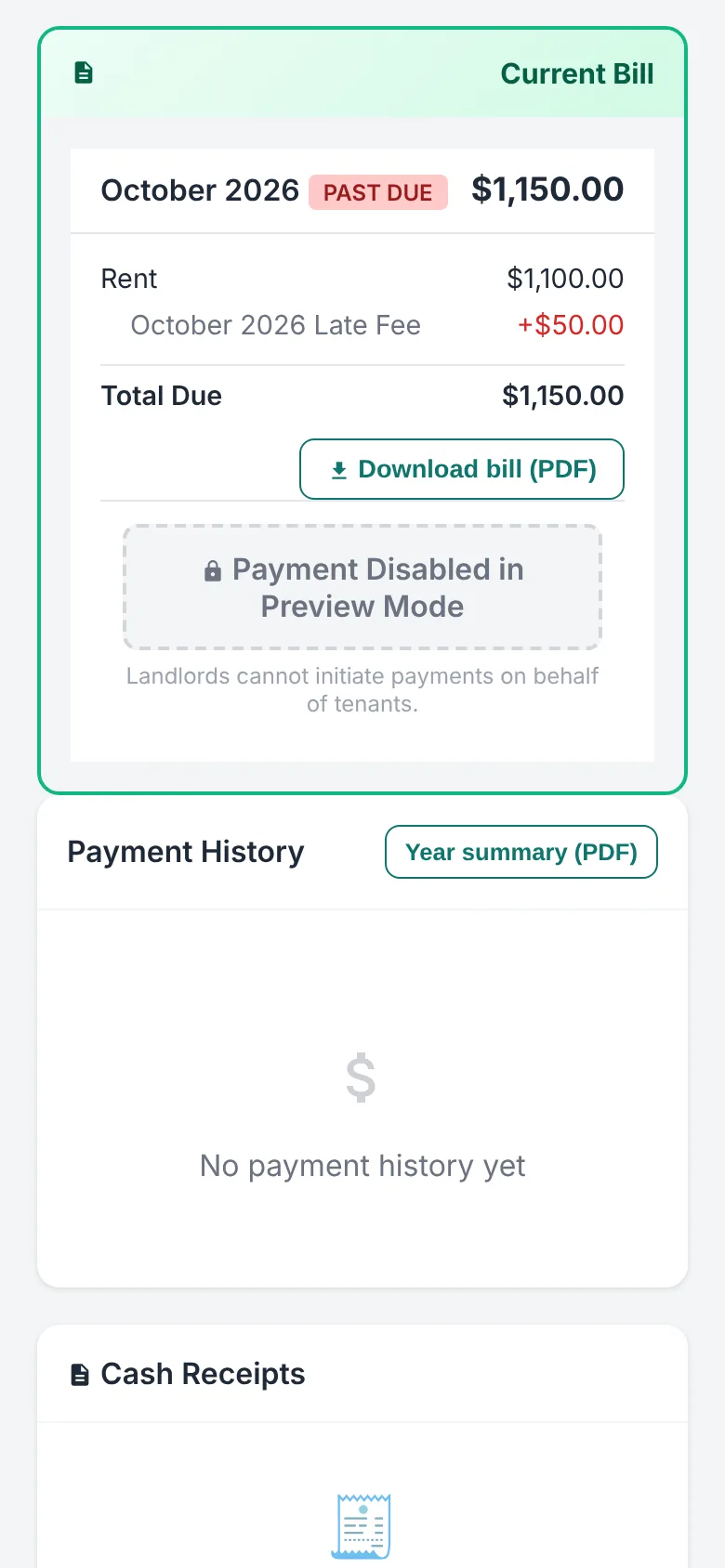
Most tenants never open the portal on a computer. On a phone the bill is the same card: the month, PAST DUE, rent, the late fee line and the total. Nobody has to call me to ask what the extra $50 is.
If you take one thing from this page: the right late fee is not a number from a template, it is your state's rule written into your lease, charged on the day the lease says. Look up the state, pick the number on purpose, put it in the lease, and let the software do the arithmetic every month after that.
Honest note: the lease wizard, the rent roll's late fees and the tenant portal are on every plan, including free, and the late fee table and calculator are free with no account. LandlordPro is software, not a law firm. Late fee caps, grace periods and notice rules vary by state and city and they change; check your state's current law or ask a local attorney before you set a fee.
Questions landlords ask about this
How much can a landlord legally charge for a late fee?
It depends on the state, and sometimes the city. Some states cap late fees at a flat amount or a percentage of rent, some only require the fee to be reasonable, and many set no figure at all. A fee is usually also limited by what the lease says. Check your state's current law, or the LandlordPro late fee table for your state, before you write a number into a lease.
Is a $100 late fee legal?
In some states it can be, if it is in the lease and a court would see it as reasonable for the rent involved. In states with a cap it may be well over the limit; on $1,100 rent a 5% cap is $55. Run your own rent and your state's rule through a late fee calculator, and ask a local attorney if you are unsure.
Does Pennsylvania cap late fees?
LandlordPro's Pennsylvania entry says the state's Landlord and Tenant Act sets no number, no percentage and no grace period, that the fee has to be reasonable, and that it has to be stated in the written lease to be collectable. Laws change and local ordinances can apply, so check the current law or ask a Pennsylvania attorney.
Do I have to give a grace period before charging a late fee?
Some states require one, ranging from a few days to a month, and others do not. Even where no grace period is required, put the number of days in the lease so you and the tenant are working from the same date, and do not charge a day earlier than it says.
Can I charge a late fee that is not in the lease?
Generally no. A late fee is a term of the lease, and in many states a fee the lease does not authorize cannot be collected. You also usually cannot add one in the middle of a tenancy without the tenant agreeing to a lease change. Put it in the lease from the start.
Is a flat late fee or a percentage of rent better?
A flat fee is simplest to explain and enforce. A percentage scales with rent and lines up with how many state caps are written. A per-day fee adds up fastest and is the most likely to run past a cap or be called a penalty, so cap the total if you use one. Whatever you choose, it has to fit your state's rule.
Run your rentals the way this page shows
LandlordPro is free for up to 4 units — the rent roll, reminders, notices and the records bundle included. No card to start.
Start freeFor informational purposes only. This is not legal advice: LandlordPro is not a law firm and cannot interpret the law for you. Laws change, and cities and counties add their own rules. Verify the current statute yourself and consult a licensed attorney in your state before taking any legal action.