
My tenant didn't pay rent. Now what?
It is the 6th. The grace period ended at midnight, the rent did not land, and the tenant who texts you about everything has not texted. Here is what I do, in order, and what it looks like in the software I built to do it.
I have run my own rentals in central Pennsylvania since 2020, thirteen units across three duplexes, a triplex and a quad. Late rent is not an emergency. It is a Tuesday. The landlords who get hurt by it are the ones who improvise: they compute a late fee from memory, send a reminder when they happen to think of it, accept a half payment with no note of what it covered, and then stand in front of a magistrate three months later with a shoebox.
Let me walk you through a real month with a tenant I will call Jim. Jim is a composite of three tenants I have had, and the screenshots are from a demo property in my own account, but every step is exactly the one I take. The point is not that software fixes a late tenant. The point is that every step leaves a record, and the record is what wins the day if it ever comes to that.
What I do, day by day
1Day 6: the rent roll shows what Jim owes, calculated straight from his lease
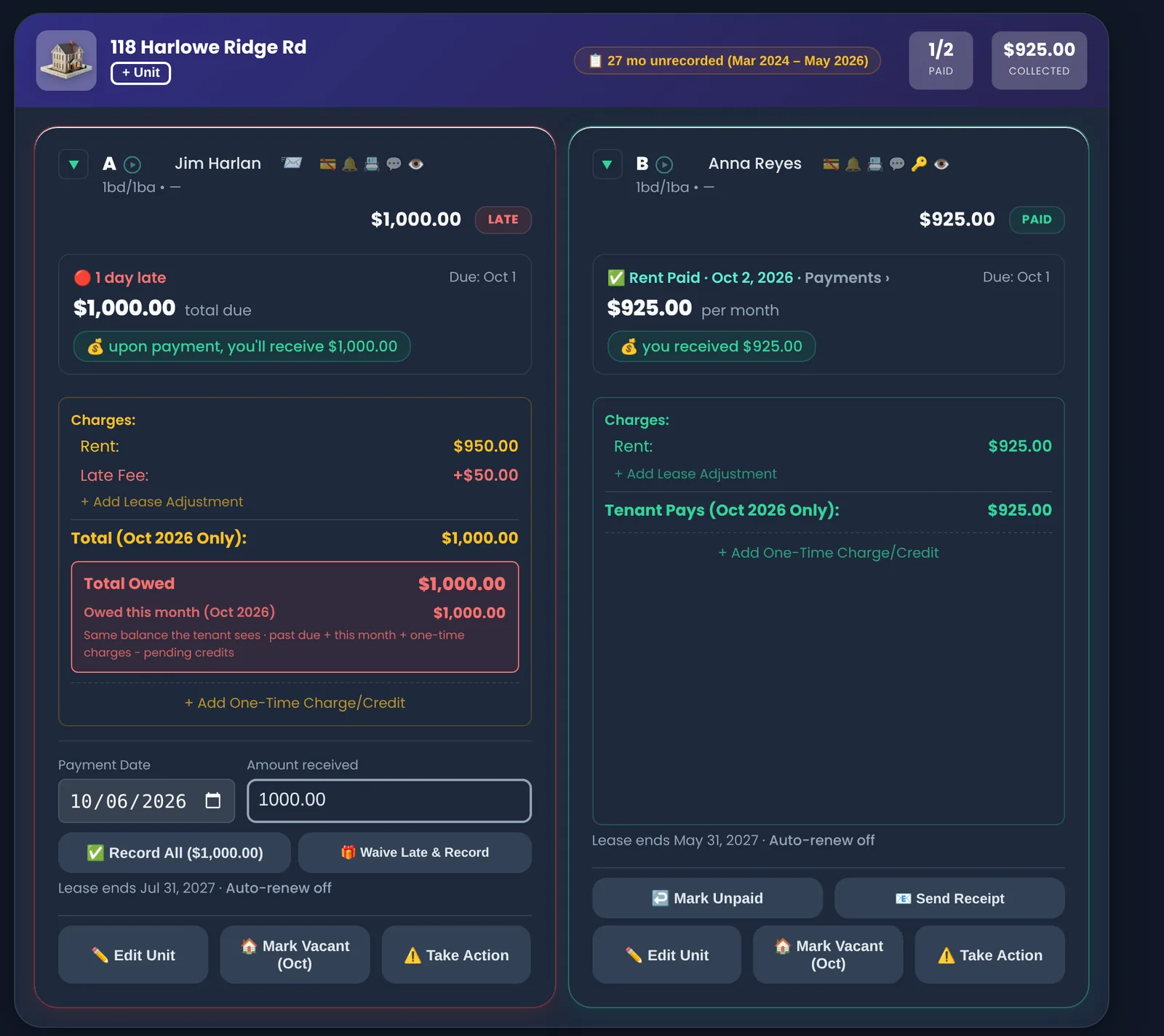
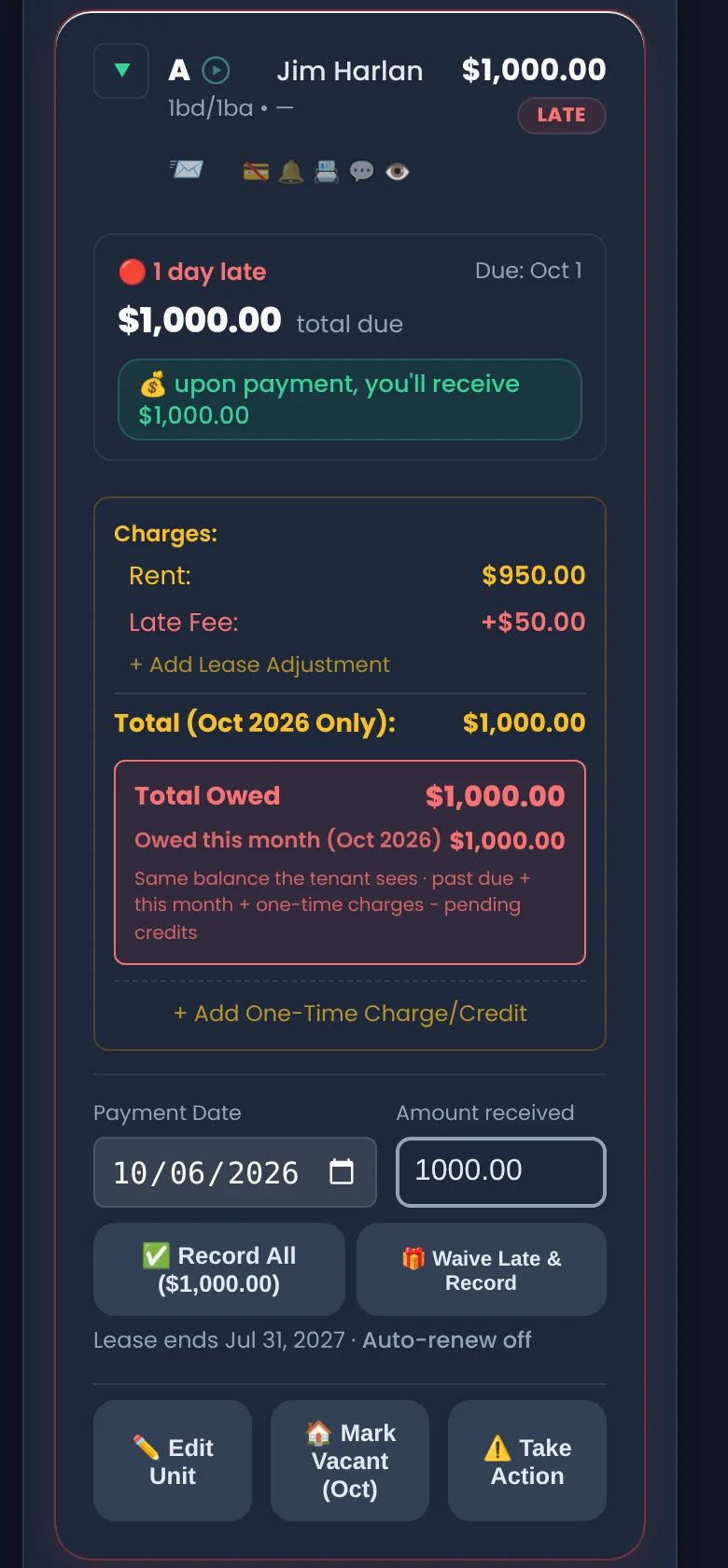
Jim's lease says $950 a month, due on the 1st, five days of grace, $50 late fee. That lease is the only input. The rent roll reads it and shows me what Jim owes this month: on the 6th his card flips from UNPAID to LATE, the $50 goes on, and the card says $1,000. I did not type a number, pick a date or decide whether the fee applies. The lease decided, and the roll did the arithmetic.
That is the piece most landlords do by hand, and it is where the arguments start: a fee charged a day early, a fee the lease never mentioned, a grace period remembered wrong. Thirteen units means thirteen leases with slightly different terms, and I want every one of them enforced exactly as written. If a lease has no late fee in it, none is calculated on the roll. Pennsylvania does not cap late fees, but a fee has to be in the lease to collect it, and a magistrate will ask.
2Day 6, same morning: the reminder goes out
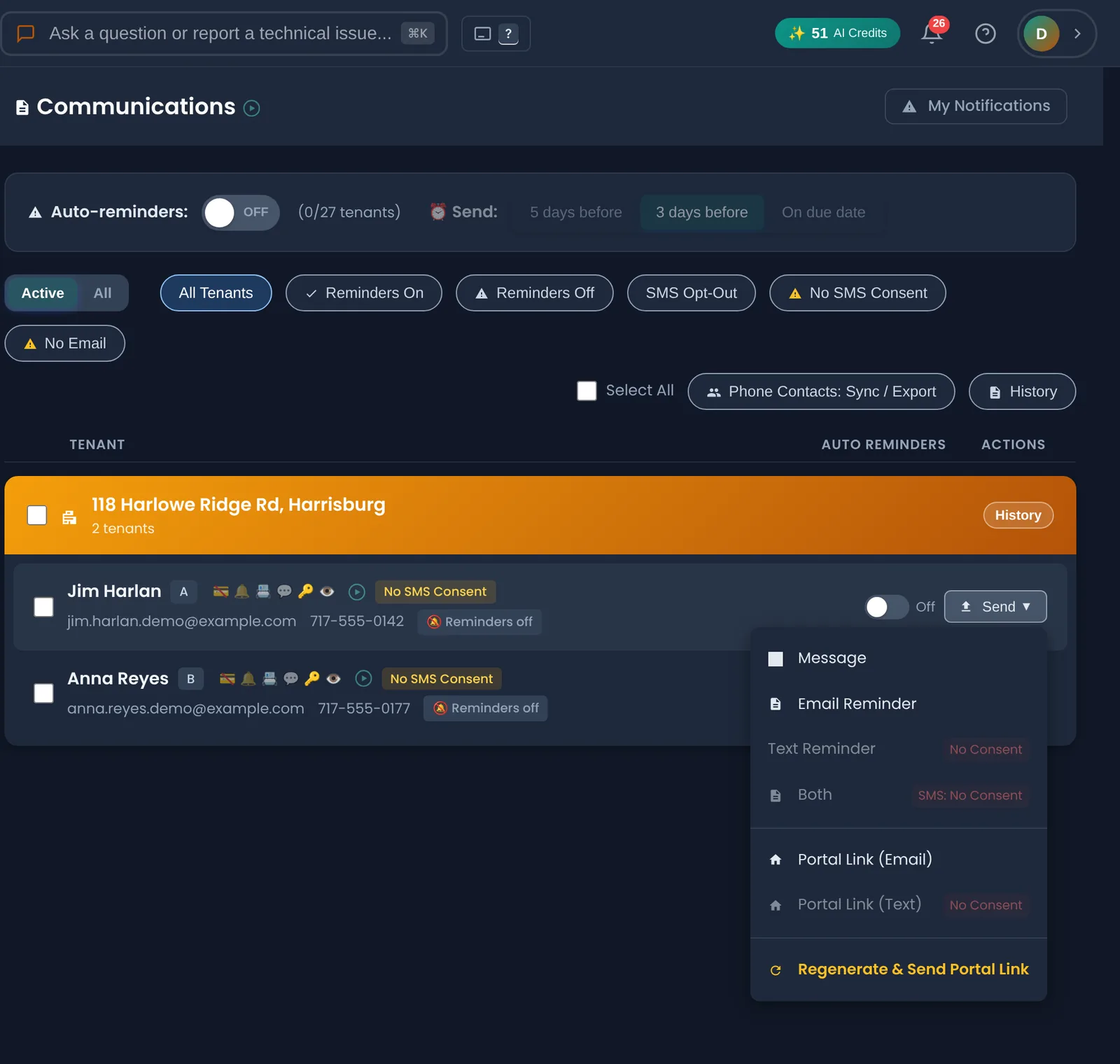
A reminder is not a threat and it is not a conversation. It is a dated record that I told Jim what he owes and when. I send it the same morning every time, for every tenant, because the one time I let a tenant I liked slide for a week, the next tenant heard about it.
From the Communications page every tenant has a Send menu: a message, an email reminder, a text reminder, or both. Text requires the tenant's consent, which the app tracks per tenant, and it will not let me text someone who has not opted in. Jim's row shows exactly that: no SMS consent yet, so he gets the email. On my own units the auto-reminders do this without me, three days before the due date and on the day.
3Day 20: Jim pays $400. The balance is not a guess
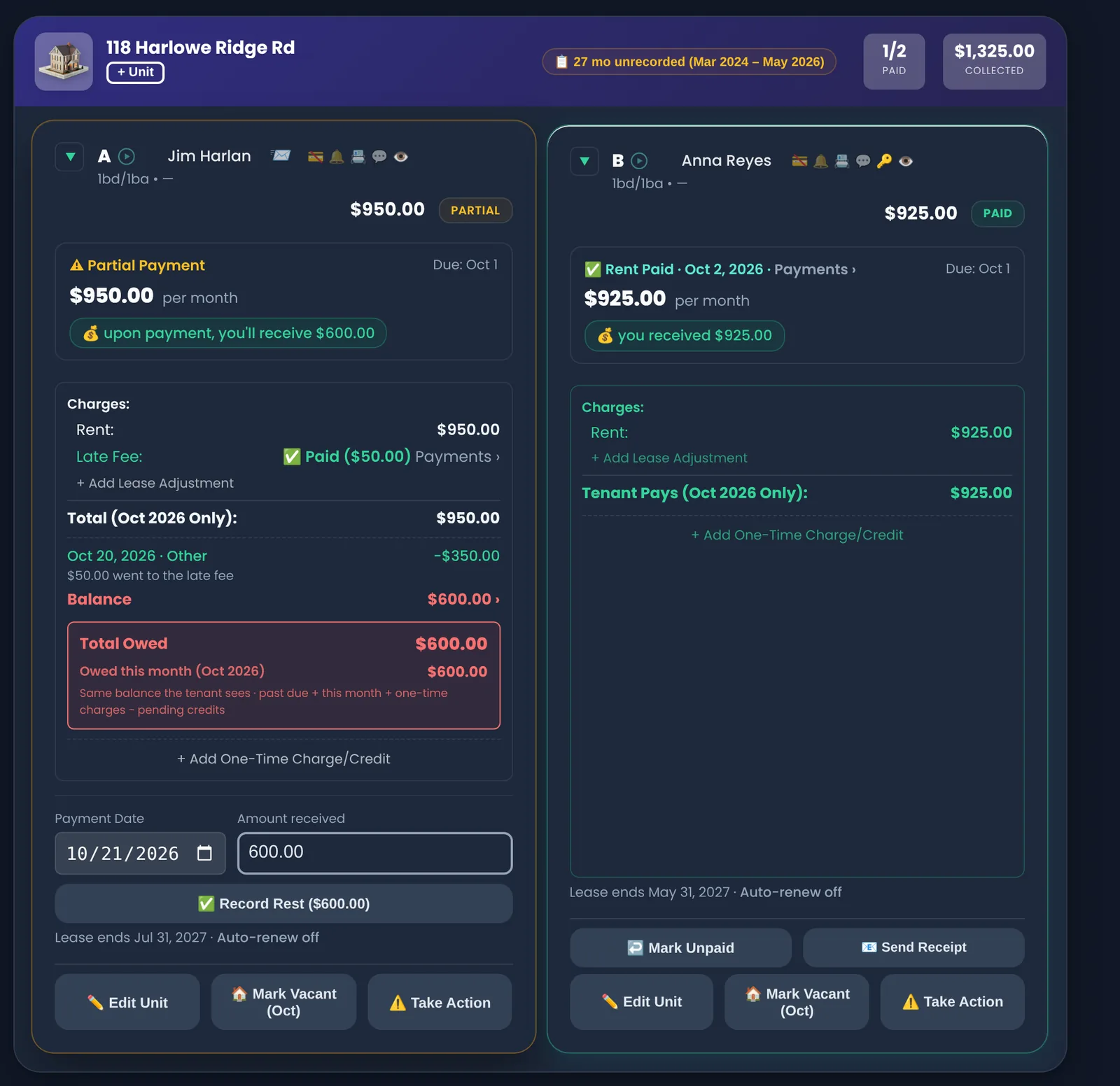
Jim shows up with $400 and a story. I take the money. I record it against his October bill with the date and the amount, and the app asks me the one question that matters: is this a partial payment with the rest still owed, or a rent reduction? Partial. The ledger puts $50 against the late fee and $350 against rent, and the card now says PARTIAL with a $600 balance.
That split is the same one the tenant sees in his portal, which is the whole point. There is one balance, computed in one place, and I never have to argue with a tenant about arithmetic. When Jim says he thought the $400 covered the fee and half the rent, the card says what happened.
4Day 21: the pay-or-quit notice, drafted for my state, signed by mePro plan
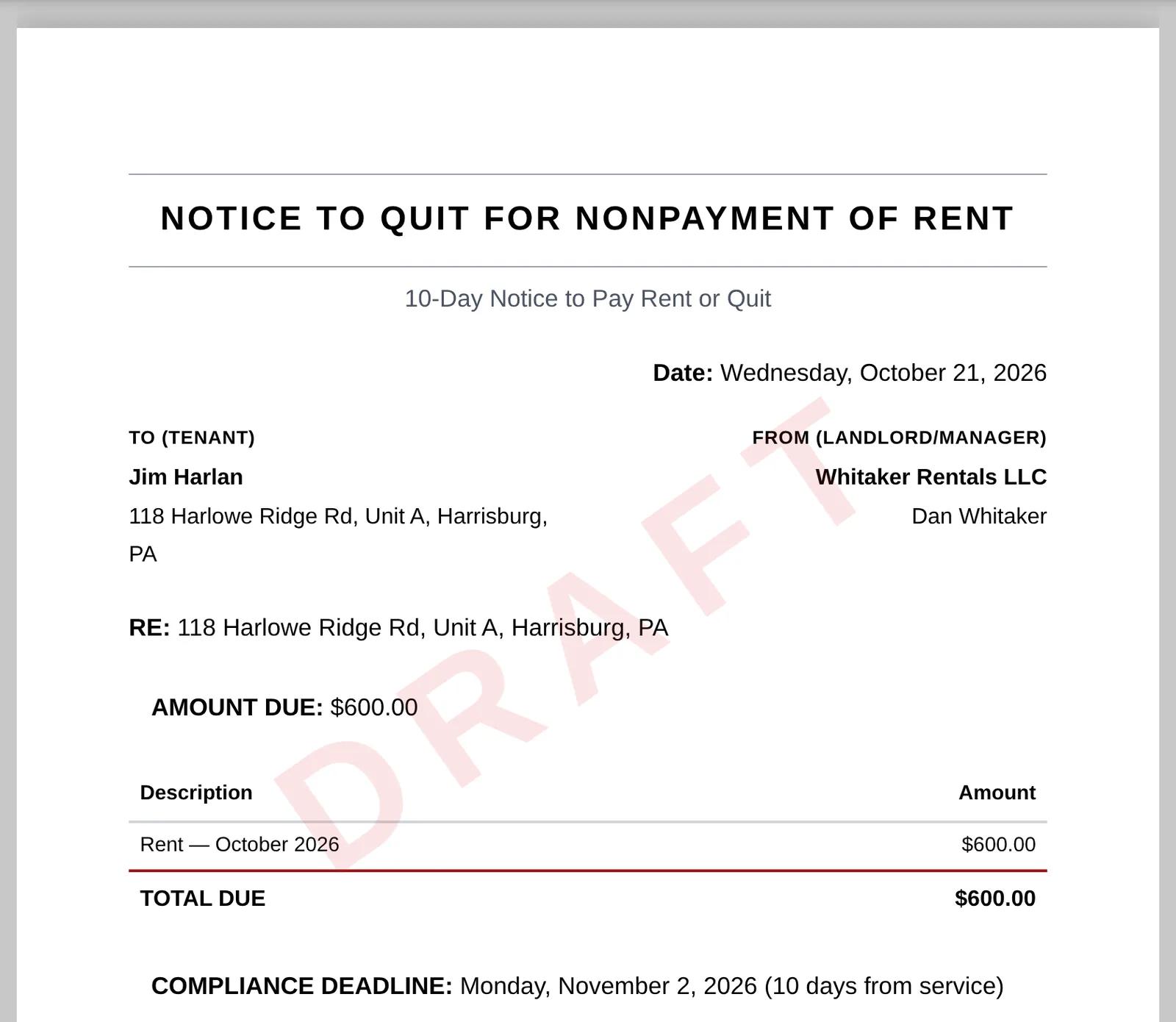
Two weeks after the due date with a balance still open, Jim gets a notice. In Pennsylvania that is a 10-Day Notice to Pay Rent or Quit, and LandlordPro drafts it with the right notice period for my state, Jim's name and unit, and the $600 he actually owes, not the $1,000 from before his partial payment.
It is a draft until I sign it. I read every notice before it goes out, because the notice is the first document a judge will look at, and a wrong amount or a wrong date on it means starting over. The DRAFT watermark does not come off until I sign. Then I serve it, the app records how and when, and that is the service record for the file.
One thing worth saying plainly: the app drafts the paperwork; it does not decide whether to evict anyone. That is my call, and in a close case it is a conversation with an attorney first.
For informational purposes only. This is not legal advice: LandlordPro is not a law firm and cannot interpret the law for you. Laws change, and cities and counties add their own rules. Verify the current statute yourself and consult a licensed attorney in your state before taking any legal action.
5Day 21 onward: the eviction clock, with every deadline on itInvestor plan
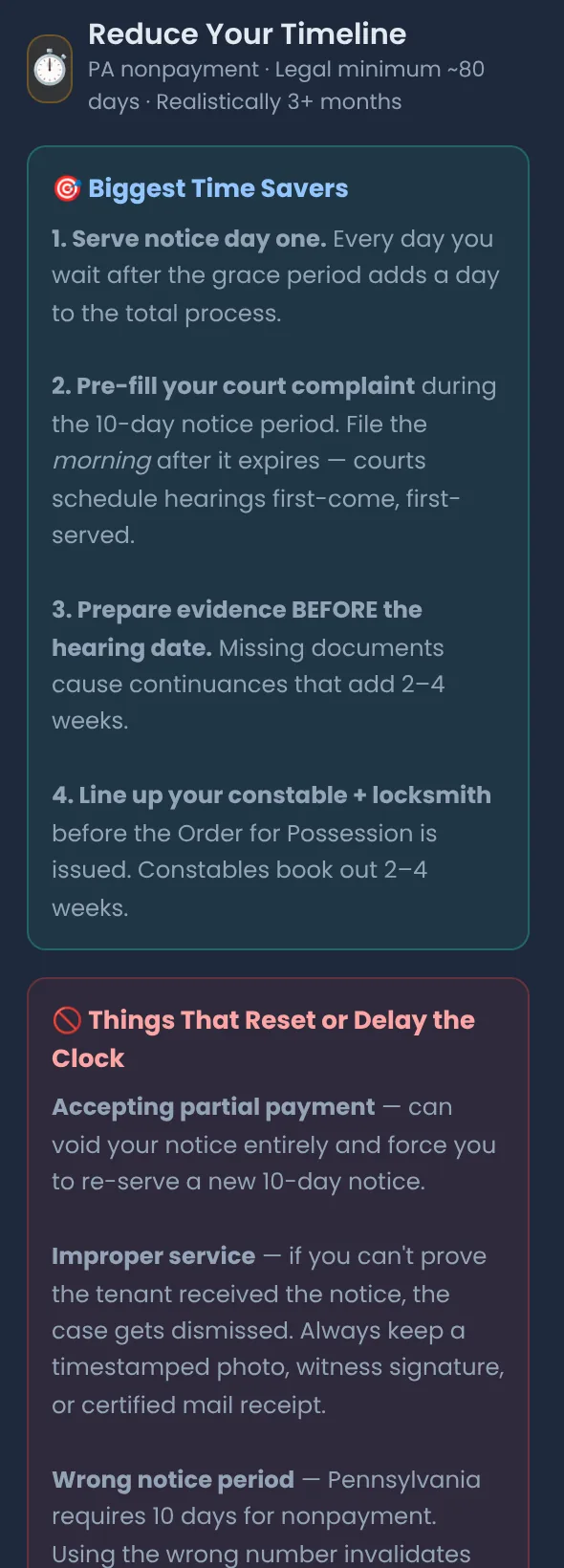
Most tenants pay inside the ten days. When they do not, the timeline tells me the sequence: notice expires, file at the magistrate, hearing, judgment, order for possession, lockout. For Pennsylvania the legal minimum works out to about 80 days from service and realistically three months or more, and the app says so instead of pretending otherwise.
The part I value most is the list of things that reset the clock. Accepting another partial payment after serving can void the notice. Sloppy service gets the case dismissed. A wrong notice period starts you over. Those are the mistakes landlords make at month two, and they are listed on the right side of the screen where I cannot miss them.
Honest note: the timeline and the records bundle below are on the Investor plan. Notices are on Pro. The rent roll, reminders and partial-payment ledger above are on every plan including free.

6Whenever it ends: the file I hand the magistrateInvestor plan
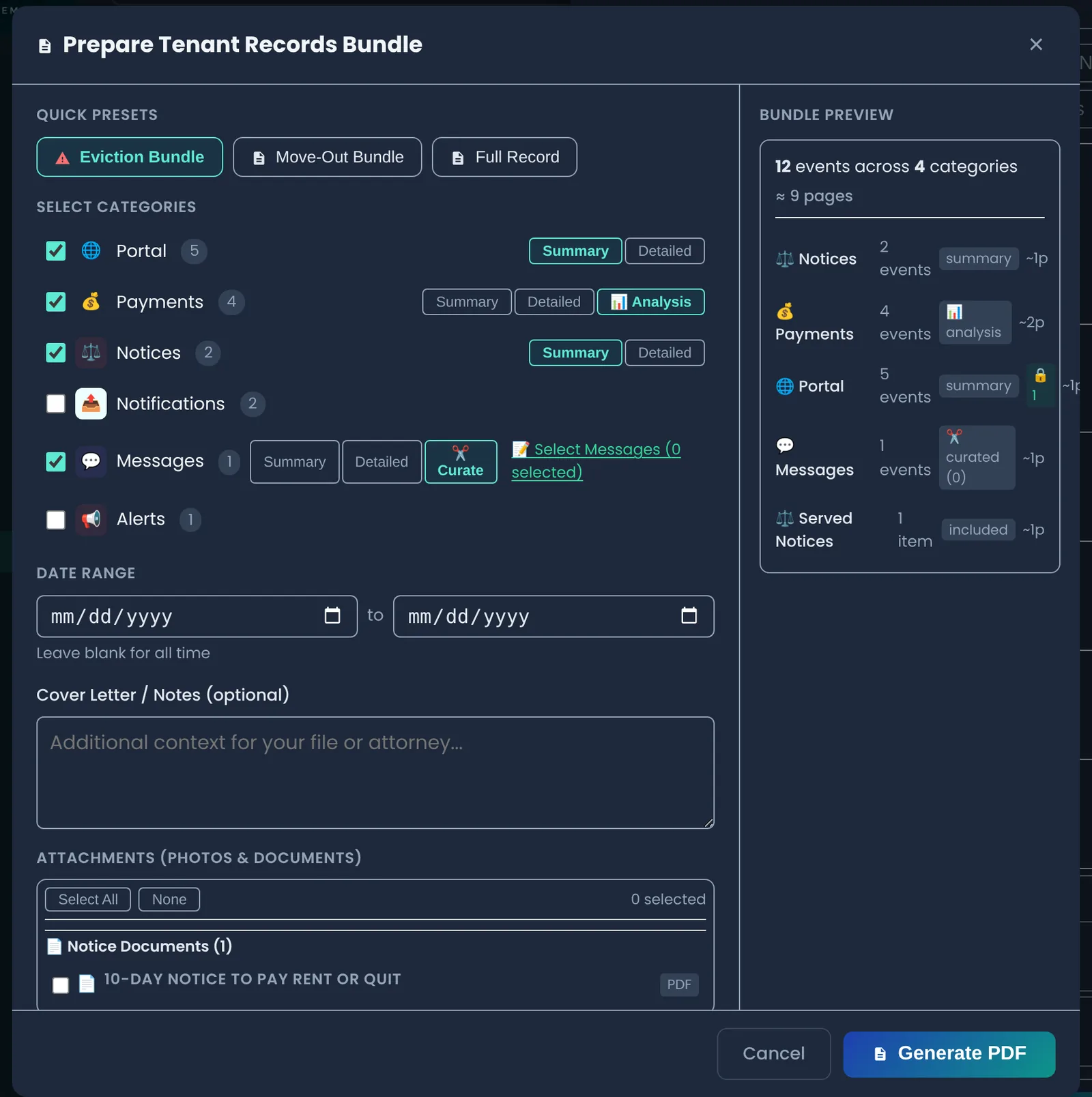
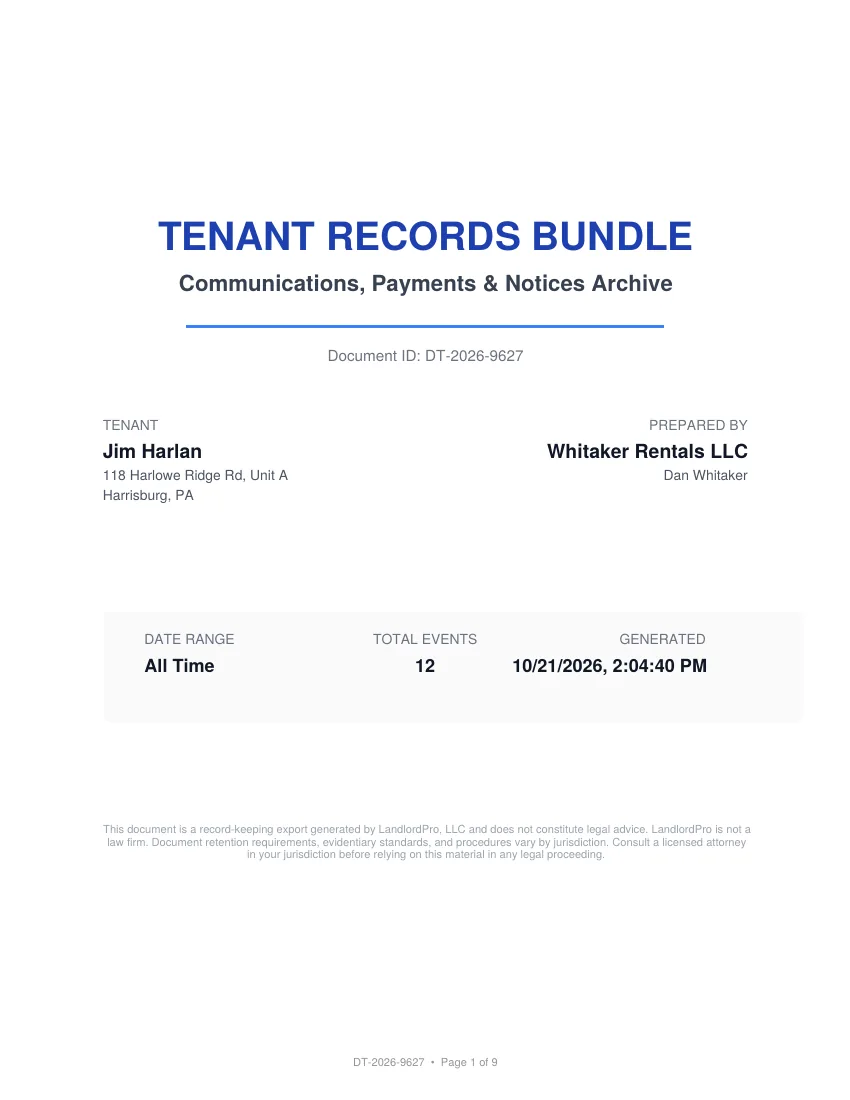
Whether Jim pays on day 9 or we end up in a hearing, the record is already built, because every step above wrote to it. The Tenant Records Bundle pulls Jim's payments, the reminder, the notice and its service record into one PDF, in date order, with a certification page I sign. I pick a preset, Eviction Bundle in this case, and it tells me what will be in it and roughly how long it will be before I generate anything.
This is the shoebox, except it is seven pages, it is in order, and I did not spend a Sunday assembling it. A magistrate who gets a clean dated file from the landlord and a story from the tenant tends to believe the file. It is a records tool, not legal advice, and I have handed the same bundle to an attorney and let them take it from there.
What this looks like from my phone
Most of the month this happens from my truck. The card on a phone is the same card: the fee, the days late, the exact balance, a Record button. I have recorded a partial payment standing in a tenant's kitchen and had the receipt in their email before I got to the door.
If you take one thing from this page: do the same thing on the same day every time, and let the record build itself. The tenants who pay late notice that you are consistent. So does the judge.
Questions landlords ask about this
How long should I wait before charging a late fee?
Exactly as long as the lease says and not a day more or less. If your lease gives a five-day grace period, the fee applies on the 6th. If the lease has no late-fee clause, you cannot add one mid-tenancy. In LandlordPro the rent roll calculates what is owed directly from the lease, so the fee goes on the day the lease says, for every tenant, every month; a lease with no late fee gets none.
What is a standard late fee for rent?
Flat fees of $25 to $75 and percentage fees of about 5% of rent are the most common in small-landlord leases. Some states cap the amount or require a minimum grace period; check your state before you write the lease. LandlordPro's state guides and late-fee calculator show the rules by state.
Should I accept a partial rent payment?
Usually yes, with the balance recorded the same day and the tenant told in writing what is still owed. The exception is after you have served a pay-or-quit notice: in many states accepting money after service can void the notice, so talk to an attorney before taking a partial payment at that stage.
When should I send a late rent notice?
A reminder the day the grace period ends; a formal notice to pay or quit once the rent is clearly not coming, typically one to three weeks later. The formal notice has a state-set period (10 days in Pennsylvania for nonpayment) and has to be served properly to count.
Can I evict a tenant myself without a lawyer?
In most states a landlord can file a nonpayment case in the local magistrate or small-claims court without an attorney, and many self-managing landlords do. The paperwork and the deadlines have to be right. LandlordPro drafts the notice and tracks the timeline; whether to file, and whether to bring an attorney, is your decision.
Does LandlordPro send the rent reminder automatically?
Yes. Auto-reminders go out 5 days before, 3 days before and on the due date by email, and by text for tenants who have opted in. You can also send one by hand from any tenant's row, and every reminder is logged with its timestamp.
Run your rentals the way this page shows
LandlordPro is free for up to 4 units — the rent roll, reminders, notices and the records bundle included. No card to start.
Start freeFor informational purposes only. This is not legal advice: LandlordPro is not a law firm and cannot interpret the law for you. Laws change, and cities and counties add their own rules. Verify the current statute yourself and consult a licensed attorney in your state before taking any legal action.