
How do I know if a rental property will cash flow before I buy it?
Every landlord forum gets this one weekly, usually with a Zillow link attached: I found a house, the rent is $1,500, the mortgage would be about $1,100, so it cash flows, right? Usually not. The gap between rent and mortgage is the number that gets people into trouble, because it leaves out the taxes, the insurance, the water bill the landlord pays, the month it sits empty, and the furnace. By the time those are in, a lot of good-looking houses are feeding on their owner every month.
I am not going to tell you which property to buy. That depends on your market, your cash and how much risk you can carry, and it is a conversation for you, your lender and your accountant. What I can show you is the check I run before I make any offer, because it takes about two minutes per property and it has talked me out of more deals than it has talked me into.
The screenshots below are the demo account with three made-up candidates: a single-family house that looks easy, a duplex that looks ordinary, and a triplex that needs work. The prices and rents are ordinary central Pennsylvania numbers so the math reads true.
How I check a deal, start to finish
1Enter the deal the way the listing and the lender describe it1 free analysis, then the Starter plan
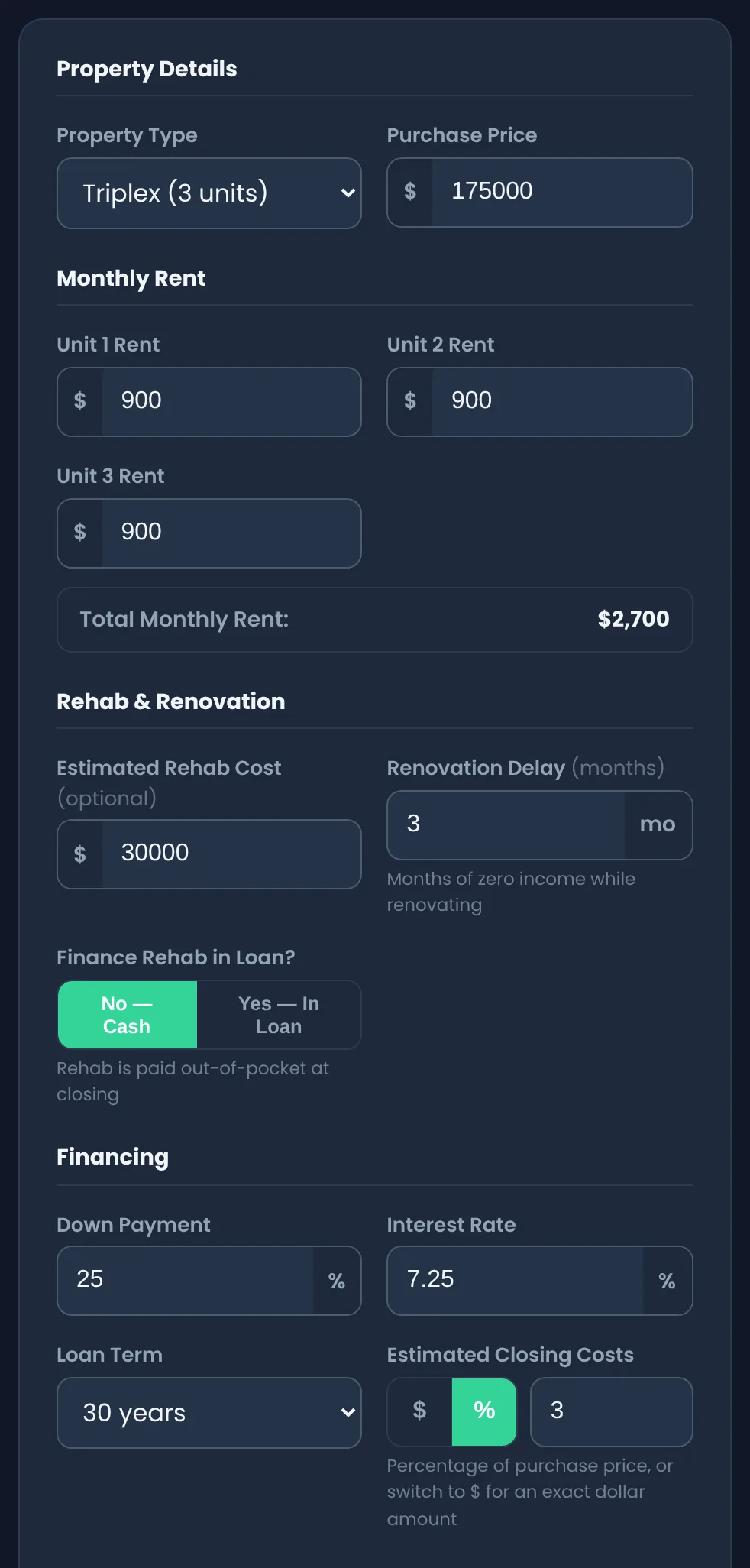
The input side is short on purpose. The property type sets how many rent boxes appear, so a triplex gets three and I enter what each unit will actually rent for, not the listing agent's optimistic total. For the triplex in the screenshot that is $900 a unit, which is what similar units rent for in town, not the $1,000 the listing hinted at.
The rehab part is where most back-of-the-envelope math falls apart. This one needs about $30,000 of work and three months before anyone moves in. Those three months are not free: the mortgage, taxes, insurance and utilities keep coming while no rent does. The analyzer counts that carry as part of the cash I need to bring, which is the number that surprises people most when they see it.
2Count the expenses the listing leaves out
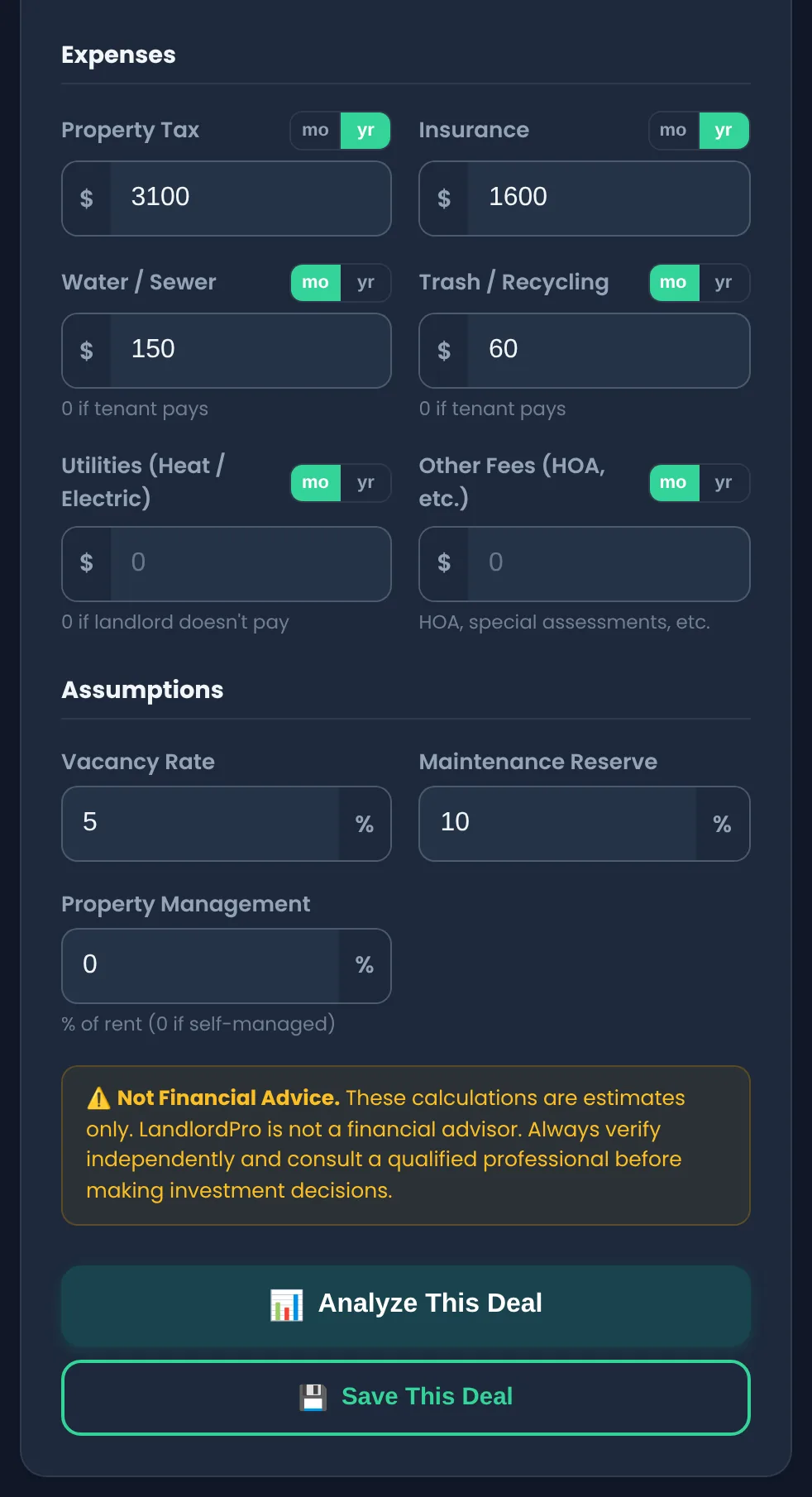
This is the step that turns a listing into a business. Taxes and insurance are easy to look up, and I enter them yearly because that is how the bills come. Then the ones people forget: in a lot of small multifamily buildings the landlord pays water, sewer and trash, which on this triplex is about $210 a month that never shows up on a listing.
The two assumptions matter more than any single bill. I hold back 5% for vacancy, because every unit turns over eventually, and 10% of rent for maintenance, because the water heater does not care about your spreadsheet. Property management is zero here because I manage my own. If you will hire a manager, put in their percentage. A deal that only works with you doing the work yourself is worth knowing about before you sign.
3Read the verdict, then the numbers a lender will ask about
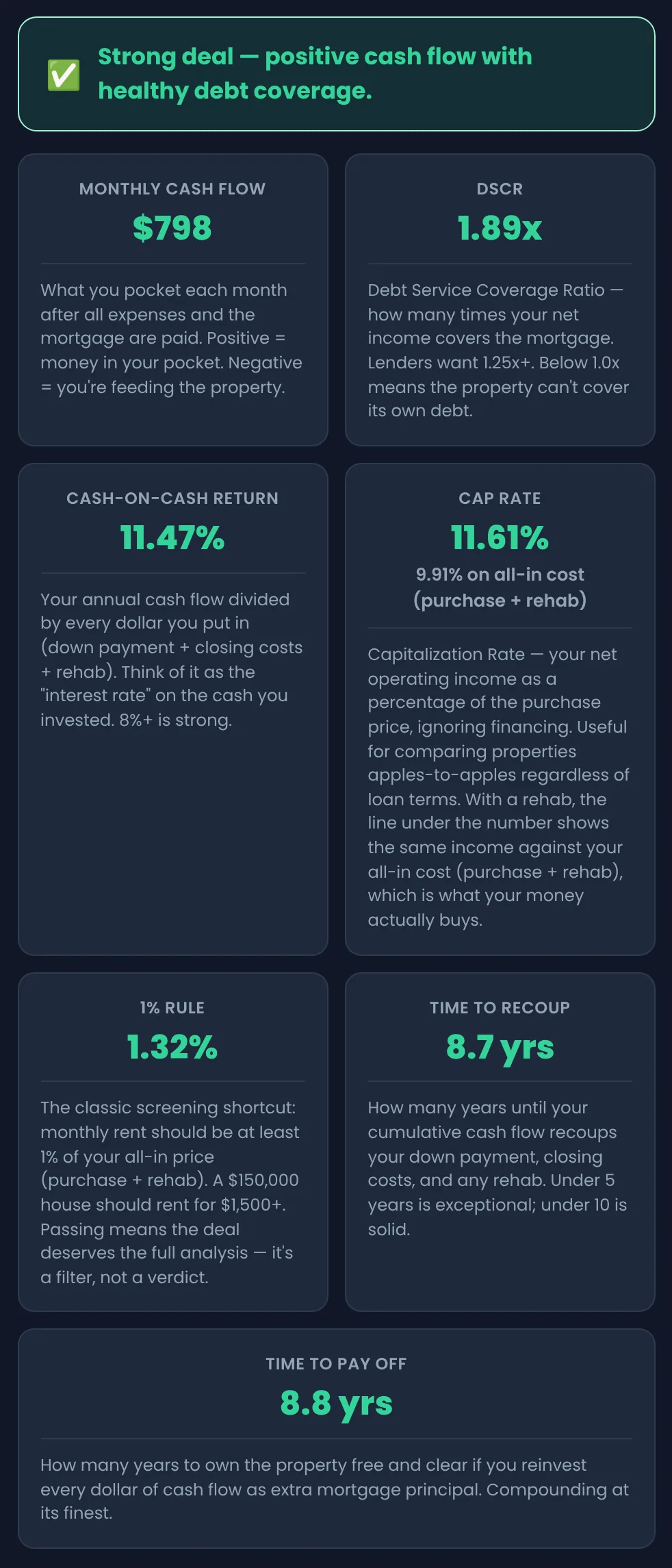
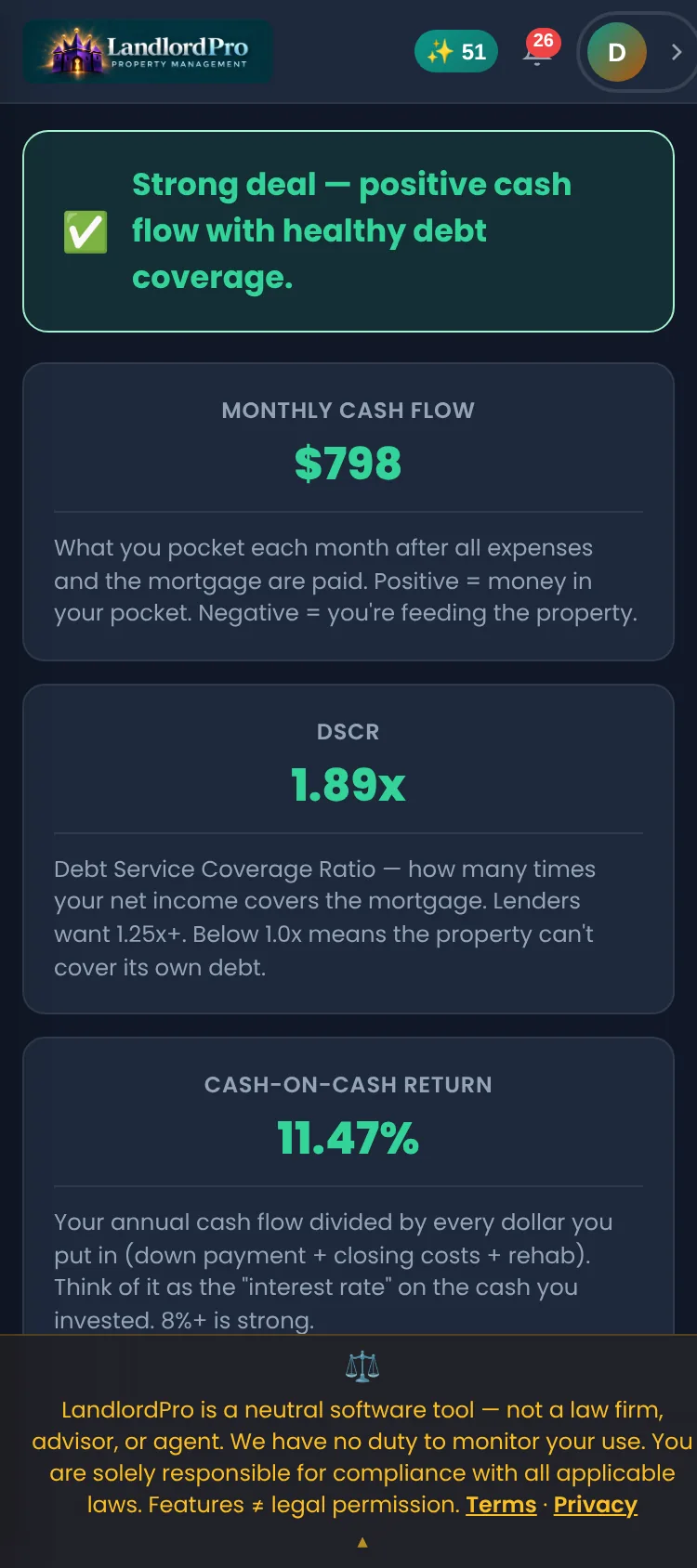
The first thing I look at is the verdict line, and the second is monthly cash flow: what is left after every expense and the mortgage. For the triplex that is $798 a month. The other tiles are the vocabulary of the forum threads, explained right under each number so nobody has to pretend they know what a cap rate is.
DSCR is the one a lender will ask about. It is the net income divided by the mortgage payment, and most investment lenders want 1.25 or better; this one is 1.89. Cash-on-cash tells me what my own money earns, counting the down payment, closing costs, the rehab and those three empty months: about 11.5%. Cap rate is the same income against the price, ignoring the loan: 11.6% on the $175,000 price, and because this one needs work, the line under it shows 9.9% on the $205,000 it really costs with the rehab, which is the honest number for a fixer-upper. The 1% rule is a quick filter, rent against the all-in price including the rehab, and it passes at 1.32%. Time to recoup says how long until the cash flow has paid me back the cash I put in.
4See where every dollar of rent goes, and how much cash it takes
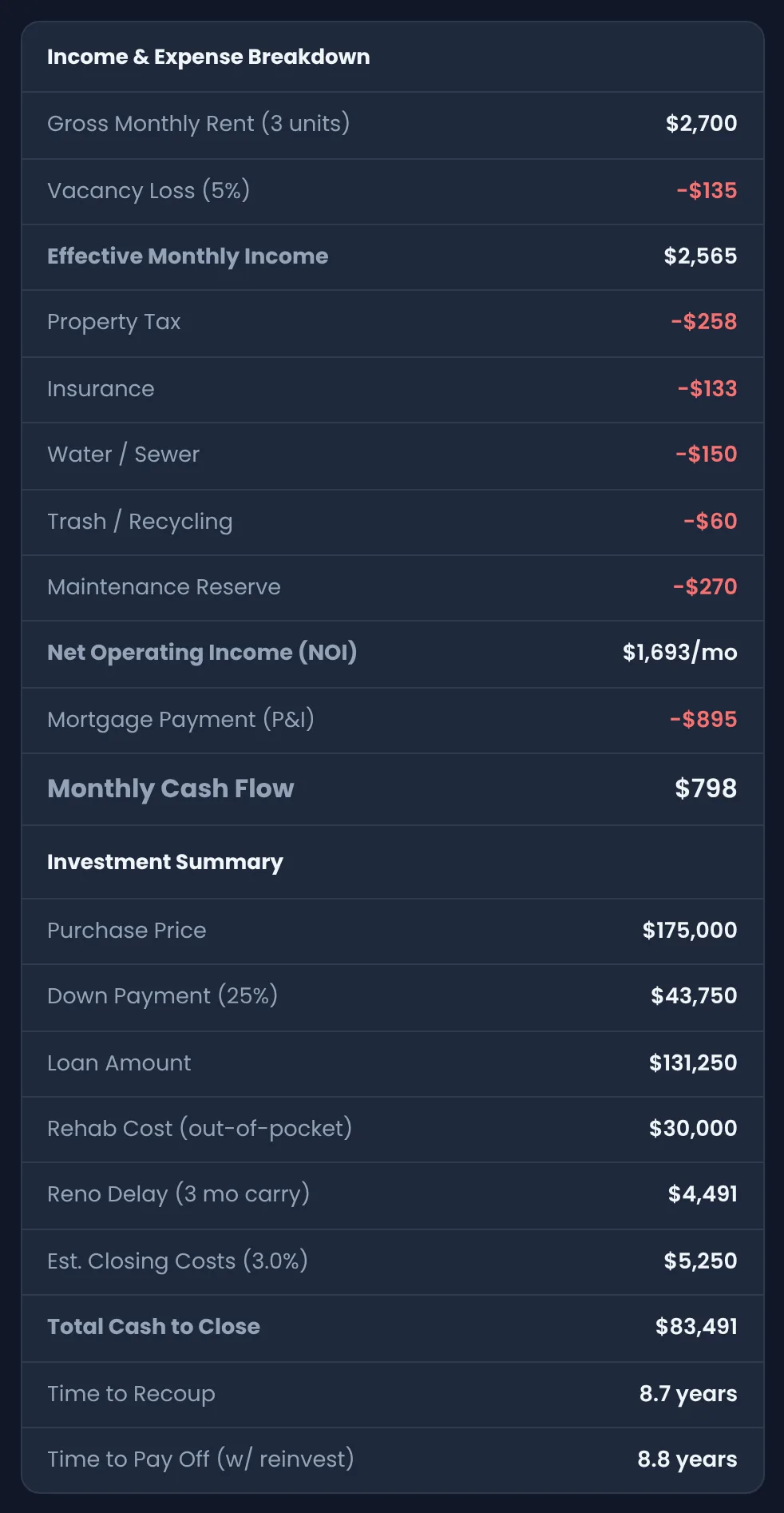
The breakdown is the part I would show a partner or a spouse, because it is the whole argument in one column. $2,700 of rent becomes $2,565 after vacancy, $1,693 after the bills and the repair reserve, and $798 after the mortgage. Nothing hidden, nothing rounded in the seller's favor.
The investment summary under it is the part that stops deals cold. This triplex needs $83,491 in cash to close: the 25% down payment, $30,000 of rehab, $5,250 of closing costs and $4,491 of carrying costs for the three months nobody is paying rent. A lot of first-time buyers have the down payment and nothing else. Better to find that out here than at the closing table. The print button makes a one-page copy for the lender.
5Put the candidates side by side and let the numbers argueStarter plan
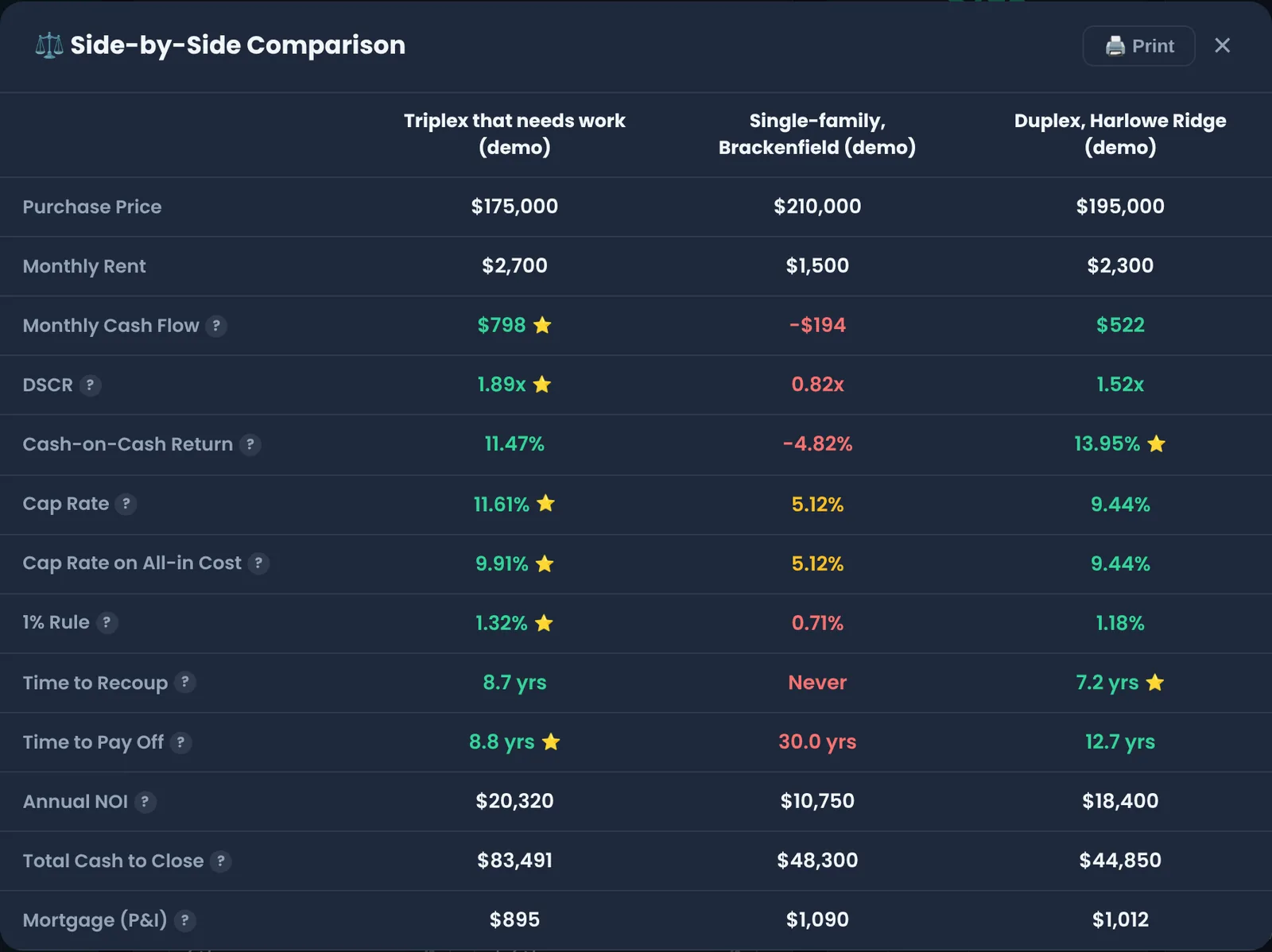
I never look at one property in isolation, because every deal looks good when it is the only one on the screen. So I save each candidate and compare them. This is where the single-family house gets found out. It is the one most new investors would pick: nice street, $1,500 rent, nothing to fix. It loses $194 a month. DSCR 0.82, which means the rent cannot cover its own mortgage, and it fails the 1% rule at 0.71%. It never pays back the cash I would put in.
The duplex is the boring, solid one: $522 a month, the best cash-on-cash of the three and the least cash to close at $44,850. The triplex throws off the most cash and pays itself off fastest, but it needs nearly twice the money up front and three months of my weekends. Which one is right depends on how much cash I have and how much work I want, and that is exactly the decision this table is for. The house that looked like a sure thing was never really in the running.
Why this is worth two minutes per property
The forum question is really asking: will this building pay for itself and pay me something on top? Rent minus mortgage cannot answer that. Rent minus everything can, and it takes about two minutes once the habit is there. The cheapest mistake in this business is the deal you run the numbers on and walk away from.
None of this is financial advice. I am a landlord, not an advisor, and the analyzer's numbers are only as good as the rents and expenses you put in. Check rents against what similar units actually lease for, get real insurance and tax figures, and talk to your lender and your accountant before you make an offer.
The deal analyzer gives one full analysis free; saving deals, comparing them side by side and unlimited analyses are on the Starter plan. If you only want the basic math, the free cash flow calculator below needs no account at all.
Questions landlords ask about this
How do I calculate cash flow on a rental property?
Start with the total monthly rent, subtract a vacancy allowance (5% is a common starting point), then subtract every operating expense the landlord pays: property tax, insurance, any water, sewer, trash or heat, HOA fees, a maintenance reserve (often 10% of rent) and property management if you will hire it. What is left is net operating income. Subtract the mortgage payment (principal and interest) and the rest is monthly cash flow. LandlordPro's deal analyzer does this line by line and shows the breakdown.
What is a good cash flow per door?
There is no single number; it depends on your market, your price point and how much risk you are carrying. Many small landlords look for $100 to $300 per unit per month after every expense and a real repair reserve, and treat anything near zero as a warning. A positive number that only appears when you leave out vacancy or maintenance is not cash flow. Compare deals on the same assumptions rather than chasing a rule of thumb.
Is the 1% rule still realistic?
It is a screening filter, not a verdict. Monthly rent at or above 1% of the all-in price (purchase plus rehab) usually means a property deserves a full analysis; well below it, as in the single-family example here at 0.71%, usually means the rent will struggle to cover the mortgage and expenses. In expensive markets few properties pass, which is exactly why the full numbers matter more than the rule.
What DSCR do lenders want for a rental property?
Most DSCR and investment-property lenders want a debt service coverage ratio of 1.20 to 1.25 or higher, meaning the property's net operating income covers the mortgage payment at least 1.2 to 1.25 times. Below 1.0 the rent cannot cover the loan on its own. Requirements vary by lender and loan type, so ask yours.
Should I include property management if I manage it myself?
It is worth running both ways. Set management to 0% for your real cash flow if you self-manage, then rerun it at 8 to 10% to see whether the deal still works if you ever hire it out, sell to someone who will, or simply get tired. A deal that only works on your free labor is fine, as long as you know that is what it is.
Is there a free version?
Yes, two. The free rental cash flow calculator on the LandlordPro site needs no account and covers cash flow, cap rate, cash-on-cash and the 1% rule. Inside the app, the deal analyzer gives one full analysis free; saving deals, side-by-side comparison and unlimited analyses are on the Starter plan.
Run your rentals the way this page shows
LandlordPro is free for up to 4 units — the rent roll, reminders, notices and the records bundle included. No card to start.
Start free