
What can't you say in a rental ad? The fair-housing mistakes small landlords make
Most fair-housing trouble for a small landlord does not start with anyone meaning harm. It starts with a friendly sentence in an ad, "perfect for a young couple", "great for a quiet single professional", or with picking the applicant who felt like a good fit. Both are how landlords end up answering a complaint, and answering one costs time and money even when you did nothing you thought was wrong.
I have run my own rentals in central Pennsylvania since 2020, thirteen units across three duplexes, a triplex and a quad. I have read a lot of rental ads in that time, and the risky ones almost never say anything hateful. They say who the landlord pictures living there. "No kids, the floors are thin." "Christian home preferred." "Must speak English so we can communicate." Each of those describes a person, and the people they describe are exactly the ones fair-housing law protects: familial status, religion, national origin.
The fix I settled on is boring on purpose. The ad describes the house and its rules, never the tenant. Anything I type myself gets checked before it can go out. Every applicant is measured against the same qualifications, in the same order. And when I say no, the reason goes in the file the same day. Here is that setup on a vacant three-bedroom I am listing. (If your problem is the forty messages a listing generates rather than the legal risk, that is a different page.)
How I keep the ad and the screening consistent
1The ad describes the house, never the personfree to build; publishing is on the Starter plan
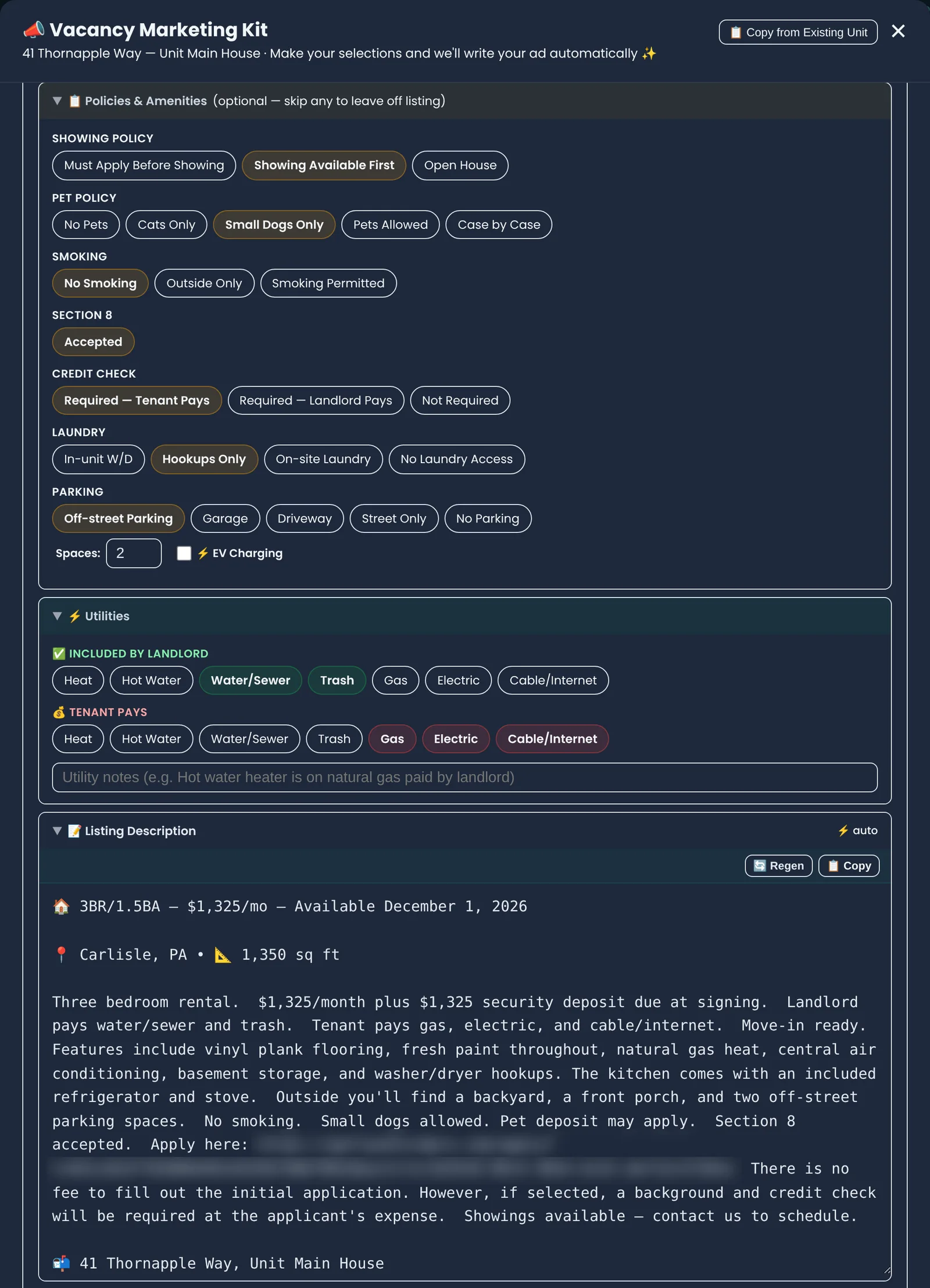
I do not write the ad from a blank box. I click what is true about the house and the description is composed from it: three bedrooms, $1,325 a month, the deposit, landlord pays water, sewer and trash, tenant pays gas, electric and internet, small dogs allowed, no smoking, off-street parking for two, credit check at the applicant's expense. Every sentence in it is about the property, the money or the process. The generated text also ends with an Equal Housing Opportunity statement.
Look at what is not on that screen. There is no pill for the kind of tenant I want, no "ideal for", no "quiet building", no occupancy-by-children setting, and the Section 8 row has an Accepted option and deliberately no opposite. If a choice would describe who lives there rather than what the house is, it is not in the list, so the ad that comes out of the pills cannot say it.
2Anything I type myself gets checked as I type it
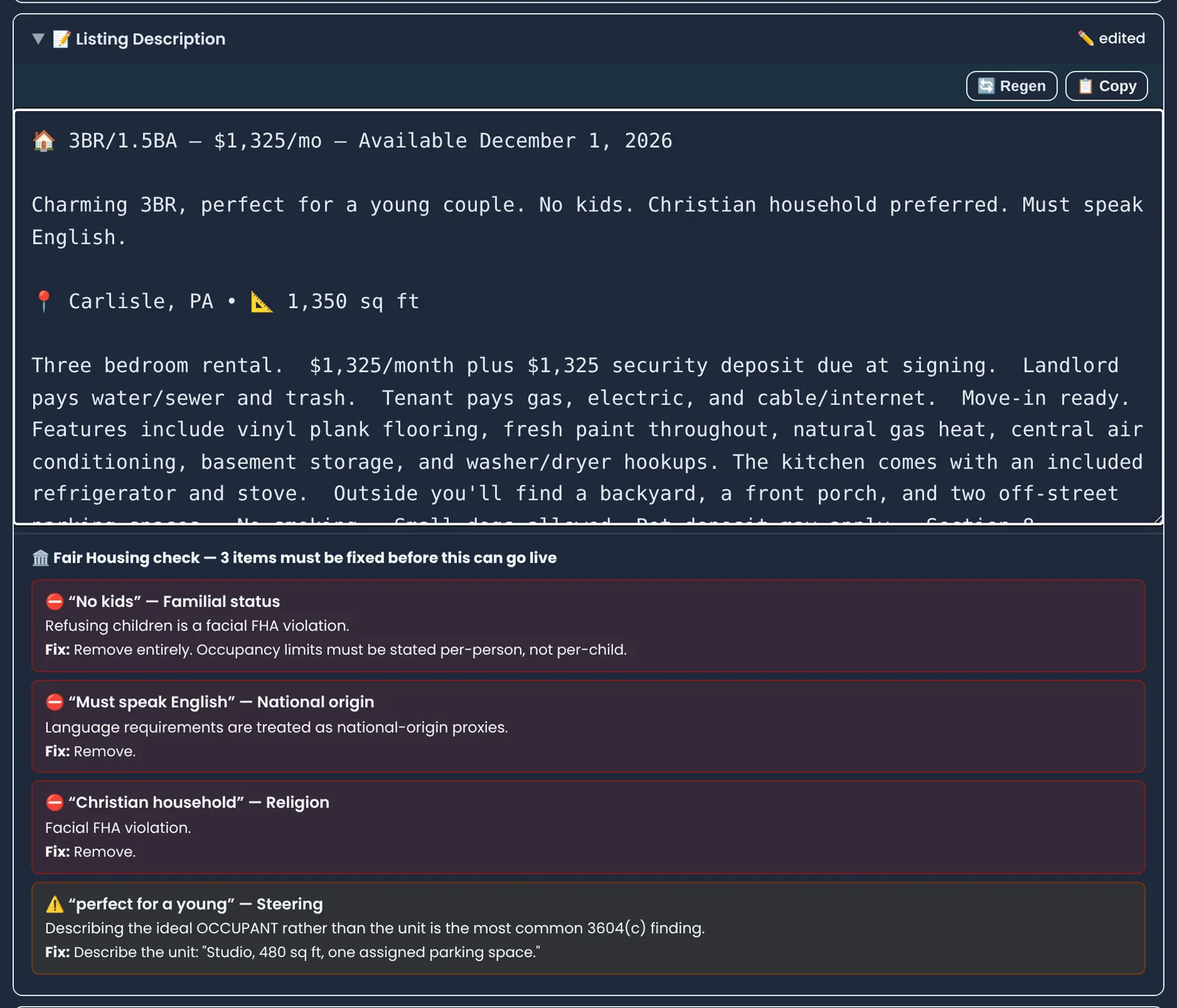
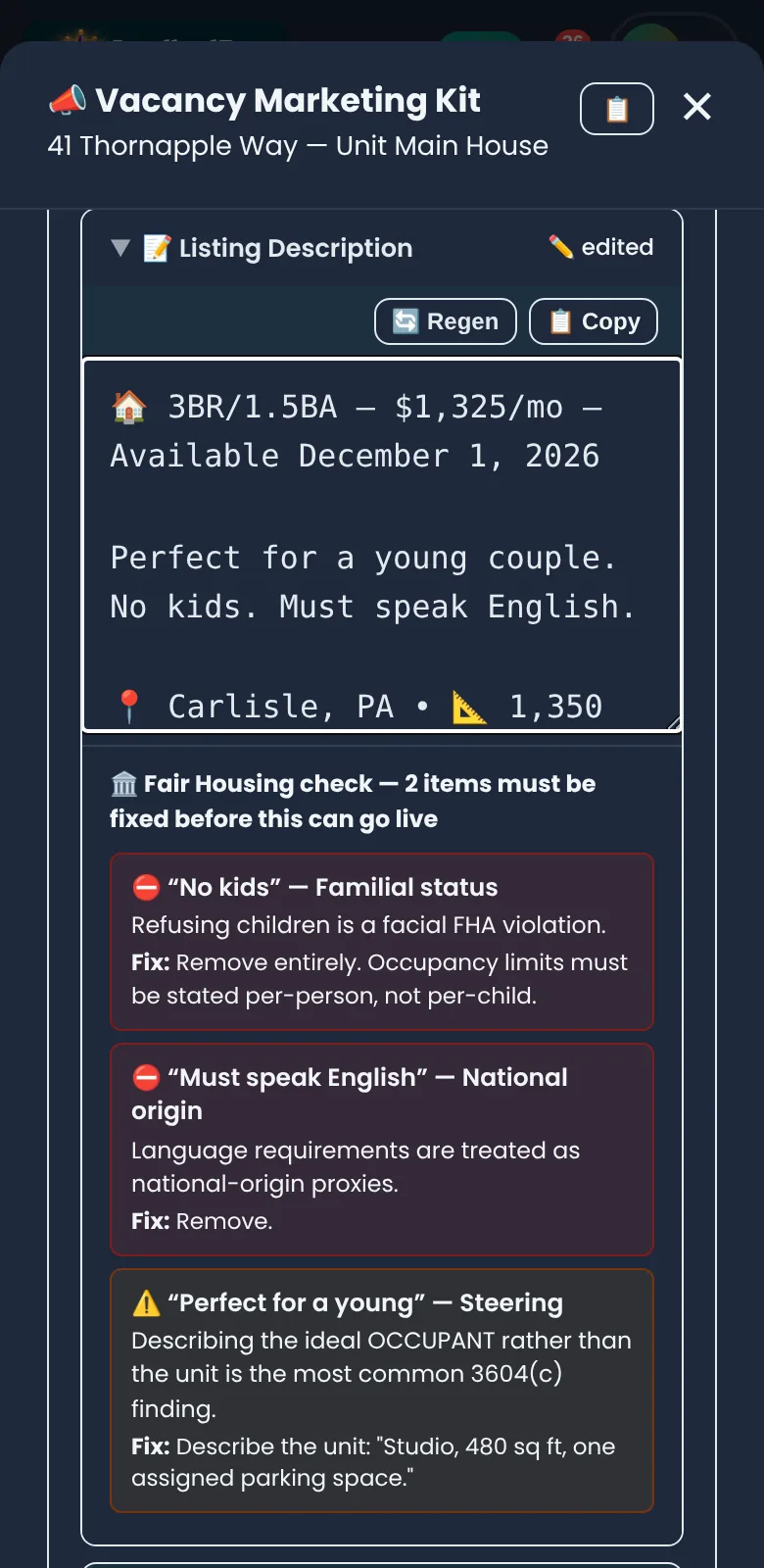
The pills only cover what the pills write. The moment I edit the description by hand, I can type anything, so the app reads what I type. Here I pasted the kind of line I see in other people's ads all the time: "Charming 3BR, perfect for a young couple. No kids. Christian household preferred. Must speak English." Before I finished, the Fair Housing check under the box had flagged three items in red, familial status, religion and national origin, and one in amber for steering, with a plain-English reason and a fix for each.
Red means the listing cannot go live until the phrase is gone. Amber is the softer stuff, describing an ideal occupant instead of the unit, which is the line I see crossed most often by landlords who would be horrified to hear it called discrimination. One click on Regen and I was back to the text built from the pills. It is a backstop that catches common phrasings, not a lawyer, and it does not replace knowing the rule: describe the property, not the person.
For informational purposes only. This is not legal advice: LandlordPro is not a law firm and cannot interpret the law for you. Laws change, and cities and counties add their own rules. Verify the current statute yourself and consult a licensed attorney in your state before taking any legal action.
3Every applicant is measured against the same qualifications
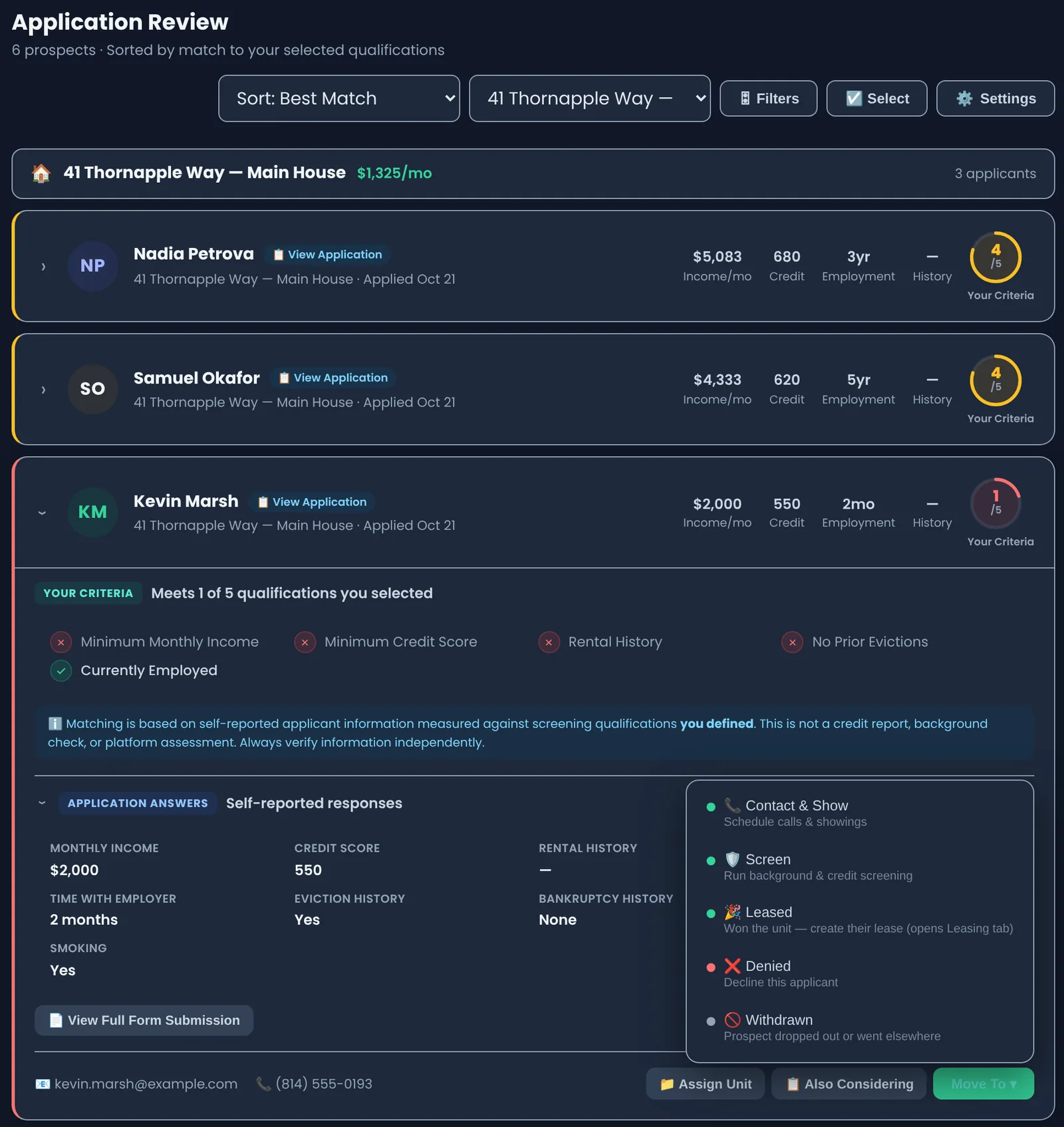
Three applications came in on this house through the same online application, which asks every applicant the same questions. The review screen checks each one against the same five screening qualifications: minimum monthly income, minimum credit score, rental history, no prior evictions, currently employed. Two applicants meet four of five. The third meets one: income under the minimum, credit under the minimum, and a prior eviction he reported himself. Open his card and it says exactly which ones.
That is the half of fair housing landlords think about less. It is not only what you say in the ad, it is whether the yardstick you use on applicant three is the one you used on applicants one and two. Gut feel is where the trouble lives, because gut feel is very good at noticing the things you are not allowed to weigh. A fixed list of qualifications, none of which is about who the applicant is, keeps me honest, and the match count is computed from what the applicant reported, so I still verify income and landlord references before I decide.
4The decision, and the reason, go in the file the same day
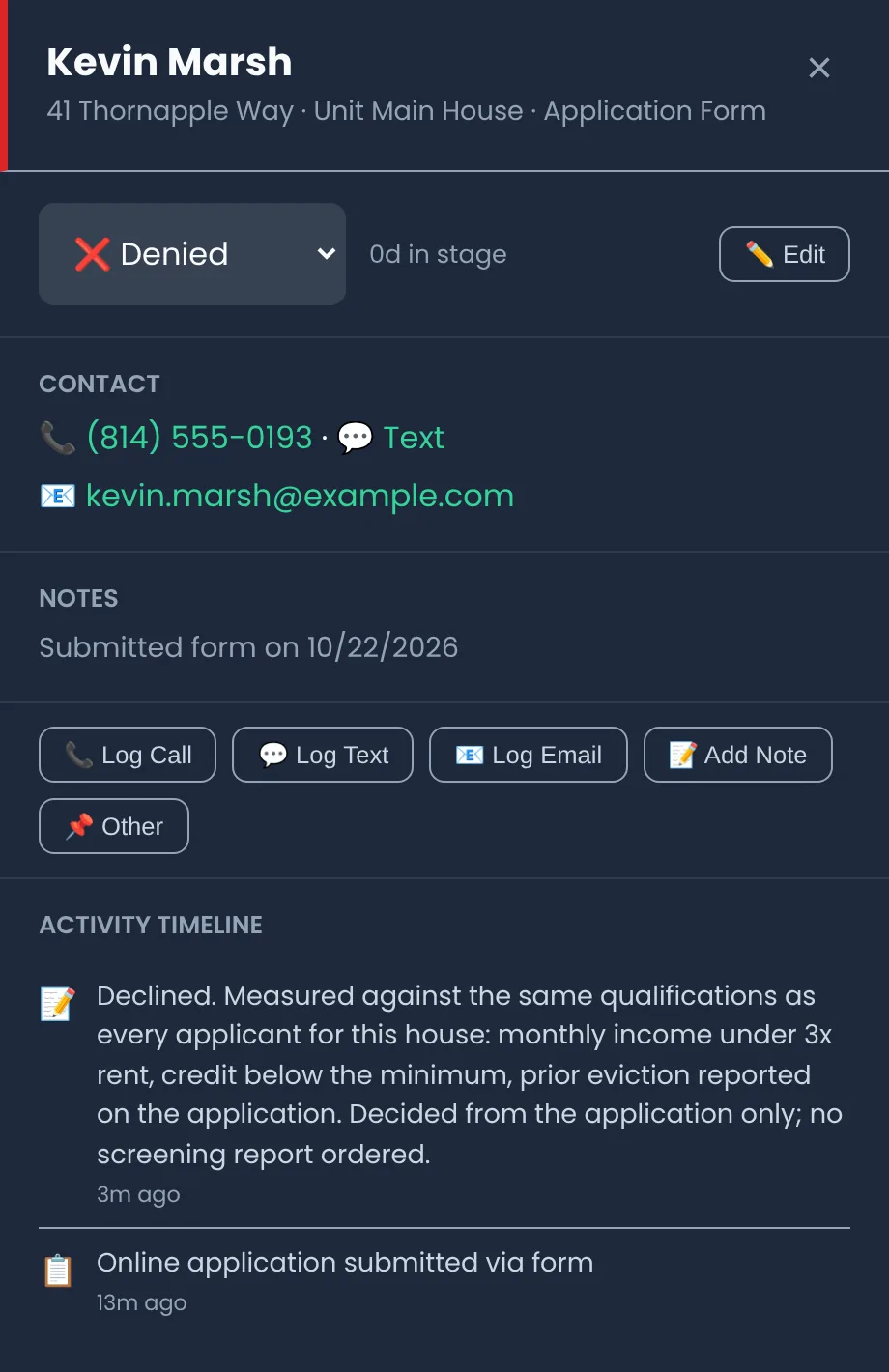
I moved the third applicant to Denied, which takes him out of the review list and into the Closed list with the date. Then I opened his record and added one note: which qualifications he did not meet, that they are the same ones every applicant for this house was measured against, and that the decision came from the application only, with no screening report ordered. It sits in his activity timeline under the application itself.
If anyone ever asks why that applicant was turned down, the answer is written down, dated, and tied to criteria that had nothing to do with who he is. That is the record I want to exist before the question comes, not one I reconstruct from memory months later. A different rule applies when a decision is based on a credit or background report: there are federal notice requirements for that, and if you order screening, follow them and check your state's rules too.
For informational purposes only. This is not legal advice: LandlordPro is not a law firm and cannot interpret the law for you. Laws change, and cities and counties add their own rules. Verify the current statute yourself and consult a licensed attorney in your state before taking any legal action.
The rule under all of it
Describe the property, not the person. Decide your yardstick before the first application, use it on everybody, and write the reason down when you say no. None of that needs software, but software that will not let me pick "ideal for a young couple" from a list, and that flags it when I type it anyway, makes the right thing the easy thing at 11 p.m. on a Sunday.
Building the ad, the Fair Housing check, the application and the review screen are on every plan including free. Publishing the listing to Zillow is on the Starter plan. Fair-housing rules also vary by state and city, and many places protect more groups than federal law does, so check yours.
Questions landlords ask about this
What can't you say in a rental ad?
Anything that states or implies a preference for or against people based on a protected characteristic. Under federal law that means race, color, religion, sex, national origin, familial status (children) and disability, and many states and cities add more, such as source of income, age or marital status. In practice that rules out "no kids", "adults only", "Christian home", "must speak English" and "perfect for a young couple". Describe the property, the rent and your policies instead. Check your state and local law, or ask a local attorney if you are unsure.
Can I put "no kids" or "adults only" in a rental ad?
Generally no. Refusing families with children is familial-status discrimination under the federal Fair Housing Act. The narrow exception is housing that formally qualifies as senior housing. If the real concern is the number of people, a reasonable occupancy standard applied to all persons is a different question; check your local occupancy code and state law before stating one.
Is "perfect for a young couple" really a problem?
It can be. Phrases that describe the ideal occupant rather than the unit can be read as a preference based on familial status, age or marital status, and fair-housing law reaches stated preferences, not only refusals. It is the most common way a well-meaning ad goes wrong. Say what the unit is: "One bedroom, 650 sq ft, second floor, off-street parking."
Can I require a tenant to speak English?
Language requirements are commonly treated as a stand-in for national origin, so leave them out of the ad and out of your criteria. Screen on things like income, rental history and references, applied the same way to every applicant. Check with a local attorney if communication is a genuine concern for a specific situation.
Can I refuse to rent to someone?
Yes, for lawful reasons that you apply the same way to every applicant: not enough income, a poor rental history, a prior eviction, failing to complete the application. You cannot refuse because of a protected characteristic, and some states and cities protect more groups than federal law, including source of income such as housing vouchers. Write your criteria down before you list, use them for everyone, and record the reason when you say no. Ask a local attorney if a case is close.
Do I have to tell an applicant why I denied them?
It depends on your state and on what the decision was based on. If it was based even partly on a credit or background report, federal law requires an adverse action notice to the applicant, and your screening company can tell you what it must contain. Either way, write the reason down in your own records the day you decide. Check your state's rules or ask a local attorney.
Run your rentals the way this page shows
LandlordPro is free for up to 4 units — the rent roll, reminders, notices and the records bundle included. No card to start.
Start freeFor informational purposes only. This is not legal advice: LandlordPro is not a law firm and cannot interpret the law for you. Laws change, and cities and counties add their own rules. Verify the current statute yourself and consult a licensed attorney in your state before taking any legal action.